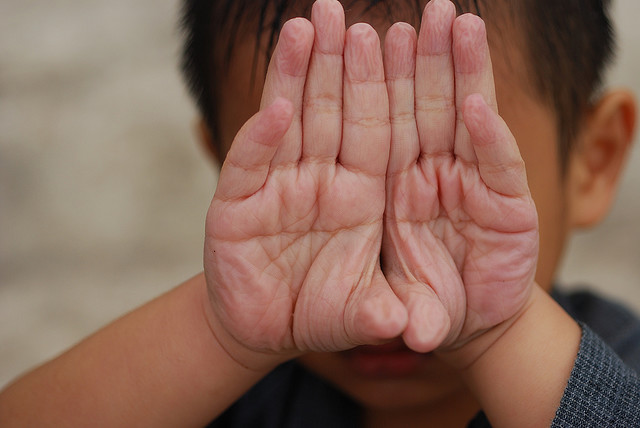
| Prune fingers give us better grip in slippery situations Long thought to be the effect of osmosis, scientists now think fingers wrinkle in the wet to give us better grip.
Human fingers go wrinkly in the bath to give us better grip in the wet, scientists have discovered, contradicting a widely held belief that osmosis is the cause.
Wet fingers and toes wrinkle after about five minutes in water but surgeons discovered nearly a century ago that cutting a certain finger nerve prevents wrinkling, suggesting that something other than osmosis was at work.
In a paper published in the journal Brain, Behaviour and Evolution, U.S. scientists report that “rather than being an accidental side effect of wetness, wet-induced wrinkles have been selected to enhance grip in wet conditions.”
The wrinkling creates a ‘tread’ similar to the tread on tyres designed for better road-grip under wet conditions, the paper said.
“We show that their morphology has the signature properties of drainage networks, enabling efficient removal of water from the gripped surface.”
In other words, the wrinkle patterns are designed to draw water away from the surface and improve grip.
“Moreover, of course, the fact that wet wrinkles happen nowhere else on the body except on the fingers and feet is consistent with this rain tread hypothesis,” the paper said.
Professor Maciej Henneberg, an expert in anthropological and comparative anatomy from the University of Adelaide and editor-in-chief of the Journal of Comparative Human Biology said wrinkling of fingers and toes is a human adaptation to life in water.
“Recently, various hypotheses relating human evolution to the life in water, mostly as wading or "grazing” in littoral areas, have been advanced by German, Belgian and Australian scholars,“ said Professor Henneberg, who was not involved in the finger wrinkle study.
“According to those hypotheses, our ancestors were what I call peri-aquatic — that is, spent a lot of time collecting foods along shores of seas, lakes and along riverbanks, often wading or immersing themselves partially in water. Littoral areas are rich in foods digestible for humans.” | Prune fingers give us better grip in slippery situations Long thought to be the effect of osmosis, scientists now think fingers wrinkle in the wet to give us better grip.
Human fingers go wrinkly in the bath to give us better grip in the wet, scientists have discovered, contradicting a widely held belief that osmosis is the cause.
Wet fingers and toes wrinkle after about five minutes in water but surgeons discovered nearly a century ago that cutting a certain finger nerve prevents wrinkling, suggesting that something other than osmosis was at work.
In a paper published in the journal Brain, Behaviour and Evolution, U.S. scientists report that “rather than being an accidental side effect of wetness, wet-induced wrinkles have been selected to enhance grip in wet conditions.”
The wrinkling creates a ‘tread’ similar to the tread on tyres designed for better road-grip under wet conditions, the paper said.
“We show that their morphology has the signature properties of drainage networks, enabling efficient removal of water from the gripped surface.”
In other words, the wrinkle patterns are designed to draw water away from the surface and improve grip.
“Moreover, of course, the fact that wet wrinkles happen nowhere else on the body except on the fingers and feet is consistent with this rain tread hypothesis,” the paper said.
Professor Maciej Henneberg, an expert in anthropological and comparative anatomy from the University of Adelaide and editor-in-chief of the Journal of Comparative Human Biology said wrinkling of fingers and toes is a human adaptation to life in water.
“Recently, various hypotheses relating human evolution to the life in water, mostly as wading or "grazing” in littoral areas, have been advanced by German, Belgian and Australian scholars,“ said Professor Henneberg, who was not involved in the finger wrinkle study.
“According to those hypotheses, our ancestors were what I call peri-aquatic — that is, spent a lot of time collecting foods along shores of seas, lakes and along riverbanks, often wading or immersing themselves partially in water. Littoral areas are rich in foods digestible for humans.” |
MENU
BILINGUAL BLOG – BLOG SONG NGỮ ANH VIỆT – SHARE KNOWLEGE AND IMPROVE LANGUAGE
--------------------------- TÌM KIẾM TRÊN BLOG NÀY BẰNG GOOGLE SEARCH ----------------------------
TXT-TO-SPEECH – PHẦN MỀM ĐỌC VĂN BẢN
Click phải, chọn open link in New tab, chọn ngôn ngữ trên giao diện mới, dán văn bản vào và Click SAY – văn bản sẽ được đọc với các thứ tiếng theo hai giọng nam và nữ (chọn male/female)
CONN'S CURENT THERAPY 2016 - ANH-VIỆT
Sunday, July 10, 2011
Why Fingers Wrinkle in Water - Tại sao da nhăn khi ngâm nước
Saturday, July 9, 2011
Why do we capitalize the word “I”? Tại sao viết hoa "I"?

Me, Myself and I
By CAROLINE WINTER
Published: August 3, 2008
Why do we capitalize the word “I”? There’s no grammatical reason for doing so, and oddly enough, the majuscule “I” appears only in English.
Consider other languages: some, like Hebrew, Arabic and Devanagari-Hindi, have no capitalized letters, and others, like Japanese, make it possible to drop pronouns altogether. The supposedly snobbish French leave all personal pronouns in the unassuming lowercase, and Germans respectfully capitalize the formal form of “you” and even, occasionally, the informal form of “you,” but would never capitalize “I.” Yet in English, the solitary “I” towers above “he,” “she,” “it” and the royal “we.” Even a gathering that includes God might not be addressed with a capitalized “you.”
The word “capitalize” comes from “capital,” meaning “head,” and is associated with importance, material wealth, assets and advantages. We have capital cities and capital ideas. We give capital punishment and accrue political, social and financial capital. And then there is capitalism, which is linked to private ownership, markets and investments. These words shore up the towering single letter that signifies us as discrete beings and connote confidence, dominance and the ambition to pull ourselves up by our own bootstraps.
England is where the capital “I” first reared its dotless head. In Old and Middle English, when “I” was still “ic,” “ich” or some variation thereof — before phonetic changes in the spoken language led to a stripped-down written form — the first-person pronoun was not majuscule in most cases. The generally accepted linguistic explanation for the capital “I” is that it could not stand alone, uncapitalized, as a single letter, which allows for the possibility that early manuscripts and typography played a major role in shaping the national character of English-speaking countries.
“Graphically, single letters are a problem,” says Charles Bigelow, a type historian and a designer of the Lucida and Wingdings font families. “They look like they broke off from a word or got lost or had some other accident.” When “I” shrunk to a single letter, Bigelow explains, “one little letter had to represent an important word, but it was too wimpy, graphically speaking, to carry the semantic burden, so the scribes made it bigger, which means taller, which means equivalent to a capital.”
The growing “I” became prevalent in the 13th and 14th centuries, with a Geoffrey Chaucer manuscript of “The Canterbury Tales” among the first evidence of this grammatical shift. Initially, distinctions were made between graphic marks denoting an “I” at the beginning of a sentence versus a midphrase first-person pronoun. Yet these variations eventually fell by the wayside, leaving us with our all-purpose capital “I,” a potent change apparently made for simplicity’s sake.
In following centuries, Britain and the United States thrived as world powers, and English became the second-most-common language in the world, following Mandarin. Meanwhile, the origin, meaning and consequences of our capitalized “I” went largely unchanged, with few exceptions.
One divergence stems from the Rastafarians, who intentionally developed a dialect of Jamaican Creole in order to break culturally from the English-speaking imperialists who once enslaved them. Their phrase “I and I” can be used in place of “I,” “we” or Rastafarians as a group, but generally expresses the oneness of the speaker with God and all people. “I and I” is thus, in some ways, a conscious deviation — really the exact opposite of the English ego-centered capital “I.”
Not long ago, certain presidential candidates could have used a bit of the “I and I” spirit. At the close of the primary season, the news media scrutinized Hillary Rodham Clinton, John McCain and Barack Obama’s use of the first-person pronoun, the implication being that a string of “I” ’s signifies ungracious self-inflation. On the last day of voting, Clinton led the pack with 64 “I” ’s and McCain followed with 60. Obama’s “I” count lagged at 30, and he was the only candidate whose combined “we” ’s (37) and “you” ’s (16) outnumbered his “I” ’s. These were spoken pronouns, but, of course, our understanding and use of language is informed by the printed word.
So what effect has capitalizing “I” but not “you” — or any other pronoun — had on English speakers? It’s impossible to know, but perhaps our individualistic, workaholic society would be more rooted in community and quality and less focused on money and success if we each thought of ourselves as a small “i” with a sweet little dot. There have, of course, been plenty of rich and dominant cultures throughout history that have gotten by just fine without capitalizing the first-person pronoun or ever writing it down at all. There have also been cultures that committed atrocities even while capitalizing “you.”
Still, there seems to be something to it all. Modern e-mail culture has shown that many English speakers feel perfectly comfortable dismissing all uses of capitalization — and even correct spelling, for that matter. But take this a step further: i suggest that You try, as an experiment, to capitalize those whom You address while leaving yourselves in the lowercase. It may be a humbling experience. It was for me.
Bắc bảo kỳ, Nam kêu cọ - one says "clean" the other "scrub"
Bắc gọi lọ , nam kêu chai
Bắc mang thai , Nam có chửa
Nam xé nửa, Bắc bổ đôi
Ôi ! Bắc quở gầy , Nam than ốm
Bắc cáo ốm , Nam khai bịnh
Bắc định đến muộn , Nam liền kêu trễ
Nam mần sơ sợ Bắc nàm lấy nệ
Bắc lệ luôn trào , Nam chảy nước mắt
Nam bắc vạc tre , Bắc kê lều chõng
Bắc nói trổng thế thôi , Nam buâng quơ vậy đó
Bắc đan cái rọ , Nam làm giỏ tre
Nam không thích nói dai, bắc chẳng mê lải nhải
Nam cãi bai bải, Bắc lý sự ào ào
Bắc vào ô tô , Nam vào xế hộp
Hồi hộp Bắc hãm phanh, trợn tròng Nam đạp thắng
Khi nắng Nam mở dù , Bắc lại xoè ô
Điên rồ Nam đi trốn , nguy khốn Bắc lánh mặt
Chưa chắc Nam nhắc từ từ, Bắc khuyên gượm lại
Bắc là quá dại , Nam thì ngu ghê
Bắc sợ ghê , Nam hãi quá
Nam thưa tía má , Bắc bẩm thầy u
Nam nhủ ưng ghê , bắc mê hài lòng
Nam chối lòng vòng , Bắc bảo chối quanh
Nhanh nhanh Nam bẻ bắp , hấp tấp Bắc vặt ngô
Bắc thích cứ vồ, Nam ưng là chụp
Nam rờ bông bụp , Bắc vuốt tường vi
Nam nói : vọt đi , Bắc hô : cút xéo
Bắc bảo : cứ véo , Nam : ngắt nó đi
Bắc gởi phong bì , bao thơ Nam dán
Nam kêu : muốn ói , Bắc bảo : buồn nôn
Bắc gọi tiền đồn , Nam kêu chòi gác
Bắc hay khoác lác , Nam bảo xạo ke
Mưa đến Nam che , gió ngang Bắc chắn
Nam khen giỏi mắng , Bắc nói chửi hay
Bắc nấu thịt cầy , Nam thui thịt chó
Bắc vén búi tó , Nam búi tóc lên
Anh cả Bắc quên , anh Hai Nam lú
Nam : ăn đi chú , Bắc : mời anh xơi
Bắc mới tập bơi , Nam thời đi lội
Wednesday, July 6, 2011
Tata becomes India's wealthiest group Tata trở thành tập đoàn lớn nhất của Ấn Độ
| Tata becomes India's wealthiest group
| Tata trở thành tập đoàn lớn nhất của Ấn Độ |
| Ratan Tata took charge of the Tata group in 1991 and is scheduled to retire in December 2012 | Ratan Tata đứng ra nhận trách nhiệm quản lý Tập đoàn Tata vào năm 1991 và theo như kế hoạch sẽ nghỉ hưu vào năm 2012.
|
| India's Tata Group has become the country's wealthiest, with a market value higher than the combined wealth of the two Reliance conglomerates. | Tập đoàn Tata của Ấn Độ trở thành tập đoàn lớn nhất của nước này, với giá trị thị trường cao hơn tổng giá trị của hai tổ hợp công ty Reliance hợp lại.
|
| The combined value of the Reliance groups, led by feuding brothers Mukesh and Anil Ambani, is $81.6bn. | Tổng giá trị các tập đoàn Reliance, do hai anh em Mukesh và Anil Ambani vốn có bất đồng mâu thuẫn đứng ra quản lý, là 81,16 tỷ USD.
|
| The Tata group, led by Ratan Tata, is worth $98.7bn (£60.9bn), according to the company.
| Tập đoàn Tata, do Ratan Tata lãnh đạo, trị giá 98,7 tỷ USD, công ty này cho biết. |
| The change is partly the result of the strengthening share prices of the almost 30 listed Tata companies.
| Sự thay đổi này một phần là nhờ kết quả của việc tăng giá cổ phiếu của hầu hết các công ty con của Tata đã được niêm yết.
|
| But it is also due to the fall in the market value of the Ambani brothers' firms over the past year. | Nhưng cũng do sự trượt dốc giá trị thị trường của các công ty anh em nhà Ambani quản lý suốt một năm qua.
|
| These firms are in a range of industries from energy to chemicals.
| Các công ty này hoạt động trong nhiều lĩnh vực công nghiệp từ năng lượng tới hóa chất. |
| The Reliance group of companies has faced challenging times as a company riven by family feuds and disputes. | Các công ty trong tập đoàn Reliance phải đối mặt với thời kỳ đầy khó khăn khi công ty bị chia rẽ bởi sự thù hằn và tranh chấp gia đình.
|
| Run by Mukesh Ambani's brother Anil, the telecoms company has faced a slump in its share prices as a result of a high profile scandal involving licenses for second generation phones. | Công ty viễn thông do Mukesh Ambani điều hành đang phải đối mặt với sự sụt giảm cố phiếu thảm hại, nguyên nhân do một vụ scandal tai tiếng liên quan đến vấn đề bản quyền cho dòng thế hệ điện thoại thứ hai.
|
| Tata's elevation to India's most valuable quoted company indicates a marked reversal from a year ago in the fortunes of the Tata and Reliance groups, the BBC's Nidhi Dutt in Mumbai (Bombay) says.
| Theo phóng viên Nidhi Dutt của BBC ở Mumbai cho biết, việc trở thành công ty có trị giá lớn nhất trên thị trường chứng khoán của Tata là dấu mốc của sự hoán đổi trong bảng danh sách công ty giàu có giữa Tata và Reliance cách đây một năm.
|
| Despite having many more companies listed on the Indian stock exchange in 2010, Tata ranked behind Mukesh Ambani's Reliance Industries, which held the top slot. Reliance has interests in the petrochemical and energy sectors, but only two listed firms.
| Mặc dù có nhiều công ty hơn được niêm yết trên thị trường chứng khoán của Ấn Độ trong năm 2010 nhưng Tata vẫn đứng xếp sau công ty đứng vị trí số 1 là Reliance Industries của Mukesh Ambani. Reliance tham gia vào lĩnh vực hóa dầu và năng lượng, nhưng chỉ có 2 công ty được niêm yết.
|
| But one year on, Tata is now not only worth more than Reliance Industries, but both it and Reliance Communications combined.
| Tuy nhiên một năm trở lại đây, Tata không chỉ có giá trị lớn hơn công ty Reliance Industries, mà còn hơn cả giá trị tổng của công ty đó và công ty Reliance Communications cộng lại. |
| Source: BBC | Translator: htdat Editor: cuckoo & Pooh |
Filipino officials bar China diplomat Philippines 'cấm cửa' quan chức Trung Quốc
| Filipino officials bar China diplomat
| Philippines 'cấm cửa' quan chức Trung Quốc
|
| MANILA, Philippines -- Philippine officials have barred a senior Chinese diplomat from attending meetings for alleged rude behavior, in the latest fallout from a feud over the potentially oil-rich Spratly Islands, Philippine officials said Tuesday.
| MANILA, Philippines - các quan chức Philippines đã cấm một nhà ngoại giao cấp cao Trung Quốc tham dự các cuộc họp do bị cáo buộc có hành vi thô lỗ, trong một cuộc tranh cãi gần nhất về chủ quyền đối với quần đảo Trường Sa giàu dầu mỏ, các quan chức Philippines cho biết.
|
| Department of Foreign Affairs officials said Chinese Embassy First Secretary Li Yongsheng, who heads its political section, raised his voice at a Filipino officer last month while discussing Philippine allegations of Chinese intrusions in Manila-claimed areas in the Spratlys. | Bộ Ngoại giao Philippines nói Bí thư thứ nhất Lý Vĩnh Thịnh, người phụ trách bộ phận chính trị của Đại sứ quán Trung Quốc, đã cao giọng với một nhân viên ngoại giao Philippines trong một cuộc họp thảo luận việc mà Manila cáo buộc là tàu Trung Quốc xâm nhập vùng biển của Philippines xung quanh quần đảo Trường Sa.
|
| A memorandum from the department's Asian and Pacific Affairs office said Li exhibited “conduct unbecoming of a diplomat” and that the embassy had been informed he would not be allowed to attend future meetings at the office.
| Một biên bản ghi nhớ của Vụ châu Á và Thái Bình Dương thuộc Bộ Ngoại giao Philippines cho hay ông Lý đã thể hiện "hành vi không phù hợp với một nhà ngoại giao" và Đại sứ quán Trung Quốc đã được thông báo rằng ông Lý sẽ không được phép tham dự các cuộc họp trong tương lai theo chức vụ của ông.
|
| Philippine Foreign Secretary Albert del Rosario has been informed about the incident, according to the memo, which was seen by The Associated Press.
| Ngoại trưởng Philippines Albert del Rosario đã được thông báo về vụ việc, theo biên bản ghi nhớ, mà đã được hãng AP nhìn thấy.
|
| The memorandum did not provide details of what happened at the meeting, but at least three senior Filipino diplomats said Li raised his voice in an offensive manner during a discussion of Manila's claims that Chinese forces intruded into Philippine territorial waters in and near the Spratlys. The diplomats spoke on condition of anonymity because they lacked authority to talk to reporters. The Chinese Embassy did not immediately respond to requests for comment.
| Các bản ghi nhớ đã không cung cấp chi tiết về những gì đã xảy ra tại cuộc họp, nhưng ít nhất là ba nhà ngoại giao cấp cao của Philippines cho biết Li cao giọng gây hấn trong một cuộc thảo luận về tuyên bố của Manila rằng lực lượng của Trung Quốc xâm nhập vào vùng biển Philippines và lãnh thổ ở gần quần đảo Trường Sa. Các nhà ngoại giao cho biết với điều kiện giấu tên vì họ không có thẩm quyền để nói chuyện với các phóng viên. Đại sứ quán Trung Quốc đã không đáp ứng với yêu cầu bình luận ngay lập tức.
|
| The Spratlys, a chain of barren, largely uninhabited islands, reefs and banks in the South China Sea, are claimed in entirety by China, Taiwan and Vietnam and in part by the Philippines, Malaysia and Brunei. They are believed to be rich in oil and natural gas and straddle busy sea lanes.
| Trường Sa, một chuỗi đảo cằn cỗi, phần lớn là các đảo không có người ở, các rạn san hô và bờ cát trong Biển Đông, được tuyên bố toàn bộ chủ quyền bởi Trung Quốc, Đài Loan và Việt Nam và một phần bởi Philippines, Malaysia và Brunei. Chúng được cho là giàu dầu mỏ và khí tự nhiên và nằm giữa tuyến đường biển nhộn nhịp.
|
| The Philippines has accused Chinese vessels of intruding at least nine times into Philippine waters in recent months, while Vietnam says Chinese vessels have hindered its oil exploration surveys in an area 200 nautical miles (370 kilometers) off its central coast that it claims as its economic exclusive zone.
| Philippines đã cáo buộc tàu Trung Quốc xâm nhập ít nhất chín lần vào vùng biển Philippines trong những tháng gần đây, trong khi Việt Nam cho biết các tàu Trung Quốc đã cản trở các việc điều tra thăm dò dầu khí của mình trong một khu vực 200 hải lý (370 km) ngoài khơi bờ biển miền Trung mà Việt Nam tuyên bố là khu vực độc quyền kinh tế của mình.
|
| China says it has sovereign rights over the entire South China Sea. The reported intrusions have set off anti-China protests.
| Trong khi đó, Trung Quốc vẫn một mực khẳng định nước này có chủ quyền "không thể chối cãi" với toàn bộ Biển Đông. |
| About a dozen protesters burned two Chinese flags near the U.S. Embassy on Monday. In Vietnam, dozens of people held protests for a fifth straight week in Hanoi on Sunday, waving Vietnamese flags and chanting anti-Chinese slogans.
| Khoảng một chục người biểu tình đốt cháy hai lá cờ Trung Quốc gần Đại sứ quán Mỹ hôm thứ Hai. Tại Việt Nam, hàng chục người đã tổ chức cuộc biểu tình tuần thứ năm liên tiếp ở Hà Nội vào ngày Chủ nhật, vẫy cờ Việt Nam và hô vang khẩu hiệu chống Trung Quốc.
|
| In the latest reported foreign intrusion into Philippine-claimed waters, an unidentified fighter plane buzzed just 20 feet (six meters) over the tip of an antenna on a boat carrying Filipino fishermen at Dalagang Bukid Shoal near the Spratlys, Defense Secretary Voltaire Gazmin said Tuesday.
| Trong báo cáo mới nhất về nước ngoài xâm nhập vào vùng biển Philippines tuyên bố chủ quyền, bộ trưởng quốc phòng Gazmin Voltaire cho biết một máy bay chiến đấu không xác định của nước nào đã bay thấp chỉ 20 feet (sáu mét) trên đỉnh của một ăng-ten trên một chiếc thuyền chở ngư dân Philippines ở Dalagang Shoal Bukid gần quần đảo Trường Sa.
|
| The fishermen, shaken but unharmed by the June 4 incident, immediately left the area, about 130 miles (210 kilometers) off Palawan province's Balabac Island. The fishermen failed to identify the aircraft, Gazmin said.
| Các ngư dân, hốt hoảng nhưng không hề hấn gì bởi sự cố ngày 04 tháng 6, đã ngay lập tức rời khỏi khu vực, ngoài khơi đảo Balabac thuộc tỉnh Palawan khoảng 130 dặm (210 km). Các ngư dân không thể xác định được máy bay của ai, Gazmin nói.
|
| On Feb. 25, a Chinese naval vessel allegedly fired to scare away Filipino fishermen from Jackson Atoll, also near the Spratlys. Chinese Ambassador to Manila Liu Jianchao denied that Chinese forces fired at the Filipino fishermen.
| Ngày 25 Tháng Hai, một tàu hải quân Trung Quốc bị cáo buộc đã bắn để xua đuổi ngư dân Philippines khỏi đảo san hô Jackson Atoll, cũng gần quần đảo Trường Sa. Đại sứ Trung Quốc tại Manila Lưu Kiến Siêu phủ nhận rằng lực lượng của Trung Quốc bắn vào các ngư dân Philippines.
|
|
| Translated by nguyenquang |
http://www.chinapost.com.tw/asia/philippines/2011/07/06/308838/Filipino-officials.htm
