MENU

BILINGUAL BLOG – BLOG SONG NGỮ ANH VIỆT – SHARE KNOWLEGE AND IMPROVE LANGUAGE

--------------------------- TÌM KIẾM TRÊN BLOG NÀY BẰNG GOOGLE SEARCH ----------------------------

TXT-TO-SPEECH – PHẦN MỀM ĐỌC VĂN BẢN

Click phải, chọn open link in New tab, chọn ngôn ngữ trên giao diện mới, dán văn bản vào và Click SAY – văn bản sẽ được đọc với các thứ tiếng theo hai giọng nam và nữ (chọn male/female)

- HOME - VỀ TRANG ĐẦU

CONN'S CURENT THERAPY 2016 - ANH-VIỆT

150 ECG - 150 ĐTĐ - HAMPTON - 4th ED.

VISUAL DIAGNOSIS IN THE NEWBORN

Thursday, August 11, 2011

Top 10 Architects' Homes - 10 Ngôi nhà đầu bảng

Top 10 Architects' Homes - 10 Ngôi nhà đầu bảng

This week, I'm going to try and inspire you by showcasing my selection of Top 10 Architects' homes. When recently I came across the ABC series In the mind of the architect, I was thrilled to see the first episode featuring Sean Godsell and his own Kew House designed for his family. As his buildings possess a certain radical austerity and experiment, Godsell's home expectedly showcased his own theoretical and architectural explorations put into practice. While the camera was rotating around the elegant metal-and-glass structure, his wife commented that

"Living here is about accepting the fact that you are in a very public domain. It's accepting the fact that your husband has a profession and the profession involves experimenting in the private domain."

One would almost admire her understanding learning that very soon after they moved in she had to get used to changing in the cupboard as there were no blinds even in the all-glass master bedroom. According to Godsell himself,

"It's a symbolic gesture as well as a pragmatic one, but it forces a socialization that we need to deal with as a society in Australia. It forces tolerance within the house."

Yet the daring and beautiful house enjoyed little tolerance from outsiders, often subjected to offensive remarks comparing it to a fish bowl, a zoo and even Auschwitz.

"There is the house you dream about living in and then the house you actually live in. Architects' houses are a third thing: we want to live in them, we dream to live in them and then we have to live in them."

says architect David Luck. And while Godsell could probably get over his symbolic and pragmatic gesture being compared to a Nazi camp, urban myths say that a family member broke his leg while trying to inhabit the famous Stonehouse of the radical Austrian Gunther Domenig. After more than 20 years of design and construction, the completion of Domenig's magnum opus in 2008 was celebrated by visionary architects like Thom Mayne, Wolf D. Prix and Hans Hollein. According to Lebbeus Woods, it was conceived as

"a work of architecture limited only by [Domenig's] imagination and skill, at once a manifesto and an experiment, the outcome of which he could not be sure of at the beginning."

And while it is called a house and its interior suggests this, the architect actually never cared much for living there; Domenig observed the construction of his ever-changing beautiful monster from a small trailer in the back yard, where he used to stay. Currently the Stonehouse is a cultural icon, housing concerts, as well as being featured in numerous magazines and television programs. The Top 10 shows more examples of Architects designing their homes - and there is more on the topic after the break.


Sean Godsell: Kew House
1 of 11
Because this building forces one to confront oneself, then if you don’t really feel good about yourself, you probably don’t like the building. There is nowhere to hide in that sense.

Günther Domenig: Stonehouse
2 of 11
Domenig's own house became a personal manifesto. With more than 20 years of construction, it was an outlet for the architect's technical and formal experiments over the years, about which he states: “I have reached my limits in every respect. Here we shall see what I really can carry out in architecture."


Frank Gehry: Gehry Residence
3 of 11
A decade before the first recognized Deconstructivist public project, Gehry took a seemingly ordinary house in Santa Monica and began transforming it through deconstructing its traditional elements and reassembling them according to a logic of his own.

Zaha Hadid: London Apartment
4 of 11
Hadid’s own flat is more of a showroom of some of her iconic art and design pieces rather than a cozy personal home. Almost entirely devoid of traditional furniture, the place reflects her style as an architect and designer, yet tells little about her personality.

John Henry: Research House
5 of 11
'Just a tin shed" is the way architect John Henry described his Research House, when years ago it was shortlisted for the Interior Design Awards. Executed in Henry's typical hands-on approach, this relatively cheap house (less than 300 000$) features an interior garden and a cascade of stairs and levels filled with the architect's collection of modern furniture.

Dominic Stevens: Stevens House
6 of 11
Architect Dominic Stevens and his artist wife built their own biodegradable house in Ireland's countryside. Stevens designed a modular system in which boxes can be added and subtracted according to changing spatial requirements. In his own words, It’s not the house as a product, it’s more the house as a process. Over the life cycle of our family growing, it can constantly adapt to the needs of different ages of children. The house is amorphous as opposed to static.


7 of 11
Ricardo Bofill discovered an abandoned cement factory in 1973 comprised of over 30 silos, underground galleries and engine rooms. He bought it and not so long after, transformed it through a diverse program featuring his own architectural office, exhibition spaces, guest rooms and a home for him and his family.

Terunobu Fujimori: Takasugi-An
8 of 11
Architect Terunobu Fujimori's "tea house placed too high" (as the name translates loosely) responds to an ancient tradition, in which tea masters were designing and building their teahouses themselves. Placed on two chestnut trees, the house is accesible through free-standing ladders and sways in the wind.

Susanne Nobis: Nobis House
9 of 11
Susanne Nobis designed this house for her own family of four. The two shed-like volumes feature areas for daily life and work, carefully separated from each other, yet preserving the feel of an aesthetic and functional entity.

Ray & Charles Eames: Eames House
10 of 11
The design of the house was proposed by the Eames as part of the famous Case Study House program (1944-1966), which commissioned major architects to design and build inexpensive and efficient model homes after the end of World War II and the subsequent housing boom. The project which later became their own home and studio reflected Eames' own needs: a young couple's space to live, work and enjoy in harmony with nature.


Perhaps an architect's home is a dream come true, a chance to unleash one's own creativity and design philosophy, often constrained by clients, cost, programme and functionality - after all, which self-respecting contractor would understand that something as trivial as blinds in the bedroom compromises the socio-political message of the building? And in the case of visionaries, it often means imposing one's own quest into the possibilities of architecture to their families, which have to accept the necessary margin of error in experimentation.

However, designing one's own house is something more than simply conducting a spatial experiment on daily life. "We should make our buildings first, then learn how to live in them.", says Lebbeus Woods and the common mantra of clients that "my house should be a reflection of my personality" here deepens to often very candid, poetic explorations of daily life and the inherent belief that architecture can actually transform people, that rather being simply a construct of comfort and utility it is a being on its own, a series of psychological snapshots of the paths one's mind took while creating and inhabiting it. Perhaps I'm stretching a bit too far here: as you'll see some of the selected designs are pretty much common-sense and would work for the majority of us, as they respond to contemporary trends and aesthetics in a tasteful, yet predictable way. And while Stonehouse could be simply seen as the expression of an egomanic spirit who had seemingly departed from the human concerns for functionality, cost and physical safety, I prefer what Lebbeus Woods has to say for it:

"The Stonehouse belongs to a different world than the one we normally inhabit, and it dares us to find ways to inhabit it, or even to talk about it. Yet here it is, both realized, and real. How real are we, as we stand in confrontation with this difficult work of architecture? Let us be grateful to Günther Domenig for giving us a chance to find out."


Famous Last Words: Writers' Words Before They Died - Những câu nói nổi tiếng trước lúc lìa đời

Famous Last Words: Writers' Words Before They Died - Những câu nói của nhà văn trước lúc lìa đời

A writer's life revolves around always knowing what to say and how to say it. But in the face of death, you'd think fear, pain and pressure would trump eloquence when speaking their last words. However, in the true form of their craft, (most of) these writers combine both honesty and eloquence to produce some of the greatest (and weirdest!) last words spoken. Here's a list of our favorite last words!

Know of any writers whose last words really stand out? Let us know in the comments!

Washington Irving (April 3, 1783 - November 28, 1859)
1 of 16
Before suffering a fatal stroke in 1859, author of "The Legend of Sleepy Hallow" and "Rip Van Winkle" Washington Irving was preparing his bed for the night when he turned to his niece and said, "I have to set my pillows one more night; when will this end already?"

Emily Dickinson (December 10, 1830 - May 15, 1886)
2 of 16
When the poet became too ill to leave her bed, Dickinson would write short notes to her family members in order to communicate. The last note she wrote read: "I must go in, the fog is rising."

Anton Chekhov (January, 29 1860- July 15, 1904)
3 of 16
Moments after Chekhov told his wife that he was about to die, he picked up a glass of champagne and said, "It's a long time since I drank champagne." After finishing the glass, he laid down on his bed and died.

Oscar Wilde (October 16, 1854 - November 30, 1900)
4 of 16
Immediately before dying of cerebral meningitis in 1900, Wilde stated "Either that wallpaper goes, or I do."

Virginia Woolf (January 25, 1882 - March 28, 1941)
5 of 16
Before committing suicide after suffering a breakdown (of which she had many in her lifetime), Woolf penned a suicide note to her husband which read: "I feel certain that I am going mad again. I feel we can't go through another of those terrible times. And I shan't recover this time. I begin to hear voices, and I can't concentrate. So I am doing what seems the best thing to do ... I can't go on spoiling your life any longer. I don't think two people could have been happier than we have been. V"

Elizabeth Barrett Browning (March 6, 1806 - June 29, 1861)
6 of 16
When her husband asked her how she felt, the writer replied, "Beautiful" before passing away.

Eugene O'Neill (October 16, 1888 - November 27, 1953)
7 of 16
As O'Neill was dying at the Sheraton Hotel in Boston, he whispered the words: "I knew it. I knew it. Born in a hotel room, and God damn it, died in a hotel room."

Jane Austen (December 16 1775 - July 18, 1817)
8 of 16
When her sister, Cassandra, asked her if she wanted anything, Jane Austen replied by saying, "Nothing, but death." Soon afterwards, she passed away.

J.M. Barrie (May 9, 1860 - June 19, 1937)
9 of 16
The "Peter Pan" author's last words were "I can't sleep," before dying of pneumonia on June 19, 1937.

Walter De La Mare (April 25, 1873 - June 22, 1956)
10 of 16
Before dying of coronary thrombosis in 1956, Walter De La Mare stated that it was "Too late for fruit, too soon for flowers."

O. Henry (William Sydney Porter) (September 11, 1862 - June 5, 1910)
11 of 16
William Sidney Porter, otherwise known as O. Henry, was quoted as saying "Turn up the lights, I don't want to go home in the dark" before passing away on June 5th, 1910 after a long battle with liver problems.

Franz Kafka (July 3, 1883 - June 3, 1924)
12 of 16
Desperate to relieve the pain that the tuberculosis caused him, he pleaded his doctor for an overdose of morphine. In a fit of rage, he shouted, "Kill me, or else you are a murderer!" which were his last spoken words.

Thomas Hobbes (April 5, 1588 - December 4, 1679)
13 of 16
Before dying of a stroke in 1679, Hobbes was said to have whispered, "I am about to take my last voyage, a great leap in the dark."

Charlotte Bronte (April 21, 1816 - March 31, 1855)
14 of 16
Charlotte Bronte's last words were spoken to her husband of 9 months, to whom she said "Oh, I am not going to die, am I? He will not separate us, we have been so happy." She died with her husband by her side later that day.

Mark Twain (November 30, 1835 - April 21, 1910)
15 of 16
A note found by Twain's deathbed read, "Death, the only immortal, who treats us alike, whose peace and refuge are for all. The soiled and the pure, the rich and the poor, the loved and the unloved."


China Begins Sea Trials of Its First Aircraft Carrier - Trung Quốc chạy thử tàu sân bay đầu tiên


China Begins Sea Trials of Its First Aircraft Carrier
By MICHAEL WINES
August 10, 2011

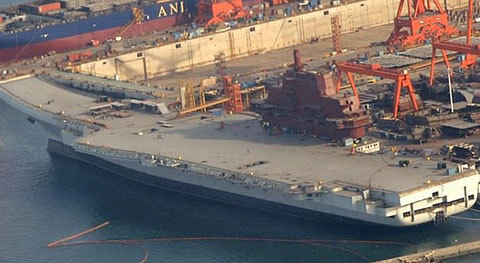
BEIJING — China’s first aircraft carrier began sea trials on Wednesday, the state-run Xinhua news service reported, a highly symbolic step in what is certain to be an effort of many years to create a carrier presence in the Pacific waters off its coast.
Enlarge This Image
Lian Min/European Pressphoto Agency

The Chinese carrier, in April, under construction in Dalian.

The carrier, once known as the Varyag, left Dalian, its northeast China port, for what analysts said would be a test of its rudder, propulsion system and other basics. Xinhua’s two-sentence report stated only that the carrier would make a short voyage before returning to Dalian for further tests.

The Chinese Defense Ministry said last month that the carrier would be used largely for scientific research and training. Foreign military analysts say it could be a decade or more before the Chinese can deploy and operate a true fleet of carriers, the most costly and complex weapons systems in any nation’s arsenal.

The launching is nonetheless a highly significant moment for China’s fast-growing military.

“It’s a milestone for them, and not only the navy. It’s a national date, too,” said Andrei Chang, the Hong Kong-based editor of Kanwa Asian Defense Review. “But it’s the first step in a long march.”

In publicly acknowledging the carrier’s existence last month, a Defense Ministry spokesman said that the vessel did not alter China’s stated policy that its armed forces were wholly defensive in nature, and that the ship had “nothing to do” with China’s continuing disputes with neighboring nations over its claim to most of the South China Sea.

A fleet of carriers would nevertheless bolster the navy’s already overwhelming military advantage over China’s smaller neighbors.

China has long been rumored to have more aircraft carriers under construction in a Shanghai shipyard, but most Chinese military matters are tightly held secrets, and that report has yet to be confirmed. Military experts say that a naval force needs a minimum of three carriers to maintain a constant sea presence because at any one time a single vessel is likely to be docked for repairs or modernization.

The ship that began sea trials on Wednesday is in fact a retrofitted version of a Soviet vessel, the Riga, that was once supposed to become the most advanced carrier in the Soviet fleet. But construction at a Ukrainian shipyard was halted when the Soviet Union collapsed in 1991. Ukraine was unable to finish construction and later stripped the ship, which had been renamed the Varyag, of its weapons and engines and put it up for sale.

A Chinese company bought the Varyag for $20 million in 1998, ostensibly to turn into a floating casino. But in 2004, workers in Dalian sandblasted the hull and repainted it in Chinese colors, then began an update. As retrofitting wound up this spring, the Chinese unveiled a carrier-based jet, the J-15 Flying Shark, an updated clone of a Soviet-era Sukhoi-33 fighter.

Many experts say the carrier is unlikely to deploy a fighter force until after 2015 because landing a jet on an aircraft carrier is a highly dangerous maneuver that requires years of training. In a blog entry posted on Tuesday, an expert on the Chinese military, Andrew S. Erickson, cited Pentagon figures showing that the United States Navy and Marines together lost nearly 12,000 aircraft and 8,500 crew members from 1949 to 1988, including 776 planes and 535 crew members in 1954 alone.

Not all those aircraft were based on carriers, but the rate of accidents for carrier-based planes was higher than that of the entire seagoing force.

“Even a less-aggressive carrier operator than the U.S. is almost certain to suffer substantial unexpected losses of aircraft and crew as it works to build its operational knowledge and human capital,” Mr. Erickson wrote. “Clearly the first Chinese carrier aviators and ship captains face steep challenges ahead.”

China's Aircraft Carrier: Why It Matters - David Millar Vấn đề tàu sân bay Trung Hoa


China's Aircraft Carrier: Why It Matters

David Millar

Vấn đề tàu sân bay Trung Hoa

David Millar

In the midst of last month's debt ceiling insanity, the Chinese Ministry of Defense quietly acknowledged what must be one of the world's worst-kept secrets: China is building an aircraft carrier. And according to an official Chinese news source, it could take to the seas in a matter of weeks.

Giữa cuộc khủng hoảng nợ trần tháng trước, Bộ Quốc phòng Trung Quốc lặng lẽ thừa nhận điều đã từng là một bí mật được giữ kín nhất: Trung Quốc đang xây dựng một tàu sân bay. Và theo một nguồn tin chính thức từ Trung Quốc, việc thử nghiệm con tàu sẽ diễn ra vài tuần nữa.

Speculation on China's naval ambitions has simmered for more than a decade, ever since a shady Hong Kong-based company bought a rusting Kuznetsov-class carrier from the Ukraine and promised to turn it into a floating casino in Macao.

Những đồn đoán về các tham vọng hải quân của Trung Quốc đã nhen nhóm và sôi lên suốt hơn một thập niên, kể từ lúc một công ty có trụ sở tại Hong Kong đánh tiếng mua chiếc tàu ngầm sân bay lớp Kuznetsov từ Ukraine và cam kết biến nó thành một sòng bạc nổi ở Macao.

Analysts were understandably skeptical of the ship's future as an entertainment venue, and suspicions deepened as the ship was towed not to Macao but to Dalian -- home of the Dalian Naval Academy and a nexus of Chinese naval manufacturing companies. To be fair, Chinese companies had turned two other large Soviet-era ships into public playtoys -- so the claim was not entirely implausible

Giới phân tích đã từng hoài nghi về tương lai con tàu như một địa điểm giải trí và sự hoài nghi ngày càng trở nên sâu sắc hơn khi con tàu hướng tới điểm đến không phải là Macao mà là Đại Liên - nơi có Học viện Hải quân Đại Liên và nhiều công ty sản xuất hải quân chủ chốt của Trung Quốc. Để cho công bằng, các công ty Trung Quốc đã mua hai con tàu lớn khác thời Liên Xô làm nơi vui chơi giải trí - khiến tuyên bố họ đưa ra hoàn toàn không có gì đáng nghi ngờ.

. But by 2005 the ship was painted in military colors, and this June a top general finally confirmed to a Hong Kong paper that the People's Liberation Army (PLA) was indeed constructing China's first carrier.

Tuy nhiên, vào năm 2005, con tàu đã được sơn màu của quân đội, và tháng 6 này, một vị tướng Trung Quốc cuối cùng đã xác nhận với báo Hong Kong rằng, quân đội Trung Quốc (PLA) thực sự đã xây dựng con tàu sân bay đầu tiên của mình.

But so what? India, Thailand, Brazil, and Italy all have aircraft carriers too, yet no one fears Rome or Bangkok taking over the world anytime soon. And as David Axe of Wired's Danger Room has written, the renovated carrier won't exactly be the terror of the high seas when it finally enters service.

Nhưng thế thì sao? Ấn Độ, Thái Lan, Brazil và Italy đều cũng có tàu sân bay, nhưng không ai lo ngại rằng, Rome hay Bangkok sẽ nắm lấy thế giới bất cứ lúc nào. Và như David Axe của Wired's Danger Room viết, một tàu sân bay được nâng cấp không chính xác là nỗi kinh hoàng trên biển cả khi cuối cùng nó được hoàn thành và đi vào hoạt động.

Chinese military electronics are pretty good, true, and the combination of mobile Su-33 fighters and SS-N-22 anti-ship cruise missiles is nothing to thumb your nose at. But with regards to the U.S. Navy, there's still at least a thirty-year technology gap between the fledgling Chinese carrier resting at port and the battle-ready U.S. Seventh Fleet prowling the seas. More importantly, the U.S. has about seven decades of experience manning, operating, and protecting a complex Carrier Battle Group -- experience not easily made up through technology. Without years of training and an integrated air-defense system, a Chinese carrier looks very much like a large, floating bulls-eye.

Hệ thống điện tử quân sự Trung Quốc khá tốt, kết hợp với các máy bay chiến đấu linh động Su-33 và các tên lửa hành trình chống hạm là điều khó có thể bỏ qua. Nhưng so với hải quân Mỹ, có một khoảng cách công nghệ ít nhất 30 năm giữa tàu sân bay Trung Quốc đang neo đậu tại cảng và Hạm đội 7 của Mỹ sẵn sàng tung hoành trên biển. Quan trọng hơn, Mỹ đã có hơn bảy thập niên kinh nghiệm đào tạo, vận hành, và bảo vệ Nhóm tàu chiến đấu phức hợp - những kinh nghiệm ấy không dễ dàng có được chỉ bằng công nghệ. Nếu không trải qua thời gian đào tạo và một hệ thống phòng không thích hợp, tàu sân bay Trung Quốc chỉ giống như một mục tiêu to lớn, nổi bật giữa biển.

The carrier program remains a popular topic of discussion, though, both here and in China. And it turns out there are some good reasons to pay attention -- because of what it may communicate about China's strategic outlook:

Cho dù vậy, chương trình tàu sân bay vẫn là chủ đề nổi bật trong các cuộc thảo luận ở cả Trung Quốc và Mỹ. Có những lý do cho sự chú ý này, vì nó có thể biểu đạt triển vọng chiến lược của Trung Quốc.

First, it draws attention to the large gap between China's military and foreign policy doctrines. That the PLA was pursuing a carrier program is perhaps not as significant as the perceived need to keep it quiet; the secrecy and frequent denials imply an agenda at odds with Beijing's professed intentions. Secrecy in itself is hardly nefarious; to some degree, all militaries are secretive. But under President Hu Jintao, the PLA has been specifically tasked with defending national interests beyond territorial integrity, even as Chinese diplomats set out to convince the world that China's rise will be marked by cooperation, not confrontation.

Đầu tiên, đó là sự chú ý tới khoảng cách lớn giữa học thuyết quân sự của Trung Quốc với nước ngoài. PLA đang theo đuổi một chương trình tàu sân bay mà họ giữ bí mật và thường xuyên phủ nhận. Bí mật không phải là điều bất chính; ở một mức độ nào đó, các quân đội đều có bí mật. Nhưng dưới thời Chủ tịch Hồ Cẩm Đào, PLA mang trọng trách bảo vệ lợi ích quốc gia vượt quá toàn vẹn lãnh thổ, thậm chí kể cả khi các nhà ngoại giao Trung Quốc cố thuyết phục thế giới rằng, sự trỗi dậy của Trung Quốc được đánh dấu bởi hợp tác, chứ không đối đầu.

As recently as the June 2011 Shangri-La Conference (an annual meeting of top Asian defense officials), Defense Minister Liang Guanglie proclaimed that "The path of peaceful development is by no means an expedient but [rather] a strategic choice... China unswervingly adheres to a defense policy [that is] defensive in nature." Perhaps the PLA leadership believes this -- but it suggests a very broad definition of "defense" that other nations are not likely to find reassuring.

Trong Diễn đàn Shangri-La (một cuộc gặp thường niên giữa các quan chức quốc phòng hàng đầu châu Á) hồi tháng 6 vừa qua, Bộ trưởng Quốc phòng Trung Quốc Lương Quang Liệt tuyên bố: "Con đường phát triển hoà bình là một chọn lựa chiến lược... Trung Quốc kiên định giữ vững một chính sách quốc phòng mang tính chất phòng thủ". Có lẽ, giới lãnh đạo PLA tin tưởng vào điều này, nhưng nó lại dẫn tới một định nghĩa rẩt rộng của "phòng thủ" mà các quốc gia khác khó có thể thấy an lòng.

Second, it communicates an intention to pursue disruptive maritime territorial claims, especially in the contested South China Sea. Maybe China's new carrier couldn't square off against the Seventh Fleet -- but it doesn't have to. All it has to do is extend China's early-warning and response capability and provide enough muscle to intimidate weaker neighbors into negotiating China's sovereignty claims.

Thứ hai, nó có thể truyền tải một ý định theo đuổi chủ quyền hàng hải ở những vùng tranh chấp, đặc biệt là Biển Đông. Có thể tàu sân bay mới của Trung Quốc khó "tác chiến" chống lại Hạm đội 7 - và nó cũng không cần làm vậy. Tất cả những gì nó phải làm là truyền tải thông điệp cảnh báo sớm cũng như khả năng phản ứng của Trung Quốc và đủ để phô diễn sức mạnh đe dọa các nước láng giềng yếu hơn trong cuộc thương thảo chủ quyền hàng hải với Trung Quốc.

A carrier group operating off China's southern coast could extend the PLA's early-warning and response capability by several hundred miles, according to Capt. Carl Otis Schuster (Ret.), a career naval analyst and instructor at Hawaii Pacific University. That, plus the larger arsenal of high-tech area-denial weapons coming on-line, could indeed change the way the U.S. and other nations operate in the Pacific region.

Một nhóm tàu sân bay hoạt động ở ngoài khơi bờ biển phía nam Trung Quốc có thể là giúp mở rộng lời cảnh báo sớm và khả năng phản ứng của PLA cách xa vài trăm km, theo Carl Otis Schuster - một chuyên gia phân tích hải quân kỳ cựu tại đại học Hawaii Pacific. Hạm đội này cùng với kho vũ khí lớn của các loại vũ khí hiện đại trên thực tế có thể thay đổi cách mà Mỹ và những quốc gia khác hoạt động trong khu vực Thái Bình Dương.

Third, it isn't one carrier-- it's three. Or maybe five. No sooner had the Defense Ministry admitted the existence of one carrier than Chinese sources confirmed the existence of two additional carriers being built in Shanghai.

Thứ ba, Trung Quốc không chỉ có một, mà là ba hay thậm chí là năm tàu sân bay. Ngay khi Bộ Quốc phòng nước này thừa nhận sự tồn tại của một tàu sân bay, thì nhiều nguồn tin Trung Quốc đã xác nhận sự tồn tại của hai con tàu sân bay khác được xây dựng ở Thượng Hải.

A PLA General further commented that "India will have three aircraft carriers by 2014 and Japan will have three carriers by 2014... So I think the number (for China) should not be less than three."

Một vị tướng PLA bình luận rằng: "Ấn Độ sẽ có ba tàu sân bay vào năm 2014 và Nhật Bản có ba tàu sân bay vào 2014... Nên tôi nghĩ rằng, số lượng (cho Trung Quốc) sẽ không nên ít hơn ba".

The addition of two indigenous carriers would put China in an entirely different class, since currently the United States is the only nation with more than two carriers in service. And it also establishes the dedicated industrial base needed to build more -- making it increasingly hard to explain away as a program for territorial defense or national prestige.

Có thêm hai tàu sân bay nội địa sẽ đặt Trung Quốc vào một "đẳng cấp" hoàn toàn khác biệt, khi hiện tại Mỹ là quốc gia duy nhất với hơn hai tàu sân bay đang hoạt động. Và nó cũng thiết lập cơ sở công nghiệp chuyên dụng cần thiết để xây dựng thêm nhiều tàu sân bay nữa, khiến chương trình tàu sân bay ngày càng trở nên khó giải thích theo kiểu chỉ là một chương trình phục vụ mục tiêu phòng thủ lãnh thổ hay vì thể diện quốc gia.

There are perhaps legitimate reasons that China is pursuing a carrier program -- and of course, we can't really stop them. But if China's leaders are simply using the "peaceful development" banner as a cover to acquire the military needed to displace the U.S. in the Pacific, that's a shame -- because the precedent of a 21st century nation rising peacefully would be hugely significant. If it holds to its stated philosophy, Beijing has the opportunity to do something historic-- something that could define the character of the 21st century as surely as superpower conflict defined the 20th. It could prove that while conflict between powerful nations may be inevitable, bloody and expensive military contests are not -- and that as a civilization, we are capable of learning from our mistakes.

Có nhiều lý do có lẽ hợp lý để Trung Quốc theo đuổi một chương trình tàu sân bay, và dĩ nhiên, chúng ta không thể thực sự chặn bước họ. Nhưng nếu các nhà lãnh đạo Trung Quốc đơn giản sử dụng khẩu hiệu "phát triển hoà bình" để che giấu cho mục tiêu thế chân Mỹ ở Thái Bình Dương, thì điều này thật đáng xấu hổ - bởi mẫu hình của một quốc gia trỗi dậy hòa bình ở thế kỷ 21 có ý nghĩa vô cùng to lớn. Nếu chương trình ấy thực sự phục vụ cho triết lý đã đề ra thì Bắc Kinh có cơ hội để làm điều gì đó có tính lịch sử. Có thể chứng minh rằng, trong khi xung đột giữa các cường quốc là điều không thể tránh khỏi thì những cuộc ganh đua quân sự đẫm máu, tổn phí lớn có thể tránh được. Và đó là văn minh, chúng ta có thể học hỏi từ những sai lầm của mình.


A senior Chinese general has for the first time officially confirmed that the country is building an aircraft carrier. According to experts and media reports, the vessel is the half-built Soviet warship Varyag, which China bought and is completing. The ship is not ready yet, Colonel General Chen Bingde, head of the People's Liberation Army (PLA) general staff said in an interview with Hong Kong Commercial Daily. His aide Lieutenant General Qi Jianguo said the ship, when it is ready, will serve as a floating training camp for Navy pilots. It will not be sent on missions to territorial waters of other countries "unlike some other nations do," the general said. While not officially confirmed, defense experts believe that the aircraft carrier is the multi-role Soviet Varyag. The ship was about 60-70 per cent complete when funding stopped in 1992 after the USSR collapsed. Ukraine, which took ownership, auctioned the vessel in the late 1990s, with the Chinese offering the highest bid of $20 million. It was believed that Varyag would be examined by military engineers to copy technology and later sold to a private company to be used as an entertainment facility. This was what happened to two other Soviet aircraft carriers Kiev and Minsk, which China bought too.


Wednesday, August 10, 2011

Demagogy Checklist - Danh sách kiểm tra lời lẽ mị dân


The Demagogy Checklist
Danh sách kiểm tra lời lẽ mị dân
Craig Chalquist, MS PhD
tiến sĩ Craig Chalquist, MS
Demagogy is the attempt to persuade through the arousal of primitive emotions and unquestioned prejudices.
Mị dân là tìm cách thuyết phục người khác thông qua việc kích thích cảm xúc nguyên thủy và những thành kiến ​​mà ai cũng nghĩ là đúng.
The following checklist is designed to help detect the deliberately propagandistic elements in any speech, sermon, or other public proclamation or communication. What differentiates demagogic propaganda from straight talk is the attempt to fog and manipulate the audience's awareness instead of appealing to its rationality and realism, those qualities upon which every democracy depends. Therefore the more of the following that are present, the more underhanded the communique. All forms of demagogy seek to unify one group at the expense of another while convincing the audience of the necessity for doing so. Psychologically, all when deliberate are expressions of pathological immaturity laced with aggressive, paranoid impulses.
Danh sách kiểm tra sau đây được thiết kế để giúp phát hiện các yếu tố cố tình tuyên truyền trong bất kỳ bài phát biểu, bài thuyết giảng, hoặc công bố hoặc giao tiếp công cộng khác. Điều khác biệt giữa tuyên truyền mị dân với nói chuyện thẳng thắn là tìm cách tung hỏa mù và thao túng nhận thức của khán giả thay vì hấp dẫn họ bằng lý lẽ và hiện thực, những phẩm chất mà mọi nền dân chủ đều phụ thuộc vào. Vì vậy, những điều sau đây càng xuất hiện nhiều, thì thông báo có tính dối trá càng cao. Tất cả các hình thức mị dân tìm cách thống nhất một phe nhóm bằng cách hy sinh phe nhóm khác trong khi thuyết phục khán giả về sự cần thiết phải làm thế. Về mặt tâm lý, tất cả lời lẽ mị dân khi có chủ ý là những biểu hiện của sự non nớt có tính bệnh lý cộng với sự bốc đồng mạnh mẽ và hoang tưởng.
- Hypnotic rhythms ("We will be strong, we will unite, we will not fail....") intended to lull the attention into trancelike suggestibility.
- Nhịp điệu giọng nói có tính thôi miên ("Chúng ta sẽ mạnh lên, chúng ta sẽ đoàn kết, chúng ta sẽ không thất bại ....") nhằm ru ngủ sự chú ý vào ám thị thôi miên
- Scapegoating: the attempt to "otherize" a given population (e.g. the Mexicans, the Arabs, those who don't share our views). Psychotherapists call this dynamic projection, an evacuation of our darker motives onto handy opponents.
- Đổ lỗi cho người khác (tạo bung xung): tìm cách "tách biệt" một nhóm dân số (ví dụ như người Mexico, người Ả Rập, những người không chia sẻ quan điểm của chúng ta). Các nhà điều trị tâm lý gọi điều này là phép chiếu năng động, chuyển động cơ đen tối của chúng ta sang đối thủ tiện dụng.
- Sweeping generalizations and oversimplifications. Free trade will erase poverty, more weapons will win the war on terror, banning rifles is an attack on personal freedom, etc.
- Sử dụng rộng rãi khái quát quá mức và đơn giản hóa quá mức. Tự do thương mại sẽ xóa nghèo, vũ khí nhiều hơn sẽ giành chiến thắng trong cuộc chiến chống khủng bố, cấm súng trường là một cuộc tấn công vào tự do cá nhân.
- Black-and-white categorization (we are good, they are evil; we're right, you're wrong).
- Phân loại hai phạm trù đen và trắng (chúng tôi là thiện, họ là ác, chúng tôi đúng, các anh sai rồi).
- A tone of sanctimonious moralizing.
- Lên giọng đạo đức (giả).
- Noble-sounding justifications for rigidity, oppression, intolerance, incompetence, indifference, or violence.
- Biện minh nghe có vẻ cao quý cho sự hà khắc, áp bức, thiếu khoan dung, thiếu năng lực, sự vô cảm hay bạo lực.
The replacement of concrete details with vague appeals to traditional values (patriotism, family, God, church).
Việc thay thế các chi tiết cụ thể bằng những lôi cuốn mơ hồ tới những giá trị truyền thống (chủ nghĩa yêu nước, gia đình, Thượng đế, nhà thờ).
Intolerance of disagreement ("you're either with us or against us").
Không dung nạp sự bất đồng ("bạn hoặc theo chúng tôi hoặc chống lại chúng tôi").
The branding of the capacity for critical self-examination as misguided, unpatriotic, or disloyal.
Dán mác năng lực tự kiểm có tính phê phán là sai lầm, không yêu nước, hoặc không trung thành.
Group narcissism disguised as loyalty (our truth is the only Truth; we are Number One; etc.).
Tự ca ngợi bè nhóm cải trang dưới dạng lòng trung thành (Chân lý của chúng tôi là Chân lý duy nhất, chúng ta là số Một, vv).
No room given to healthy self-doubt or the recognition of ambiguous realities in a given situation.
Không có chỗ cho sự tự nghi ngờ lành mạnh hoặc công nhận các thực tế không rõ ràng trong một tình huống nào đó.
Recurrent appeals to the "self-defense" argument as a justification for domination.
Thường xuyên thu hút người nghe vào lập luận “tự vệ” như là một biện minh cho sự thống trị.
A childlike assumption of entitlement.
Một giả định về quyền lợi mang tính trẻ con.
A childlike sense of omnipotence.
Một cảm giác toàn năng mang tính trẻ con.
Euphemisms (e.g., "targeted defense" rather than "assassination"; "spiritual guidance" and not "intimidation").
Dùng uyển ngữ (ví dụ, "phòng thủ có mục tiêu" thay vì "ám sát", "hướng dẫn tinh thần" thay vì "đe dọa").
Imposition of group norms described in terms of unity and solidarity (we do this for the good of all).
Áp dụng các chuẩn mực nhóm theo kiểu thống nhất và đoàn kết (chúng tôi làm điều này vì lợi ích của tất cả).
Minimization of the potential dangers of one's actions; whitewashing of unjust consequences.
Hạn chế tối đa những nguy hiểm tiềm năng của hành vi của mình, tẩy sạch các hậu quả bất chính.
Peer pressure, subtle or outright.
Áp lực lên đối thủ, tế nhị hoặc công khai.
Threats, implied or overt.
Đe dọa, ngụ ý hay công khai.
Blaming the opponent for one's own aggressive actions.
Đổ lỗi cho đối thủ của mình là nguyên nhân gây ra hành động hung hăng của mình.

It takes tremendous courage to resist the lure of appearances. The power of being which is manifest in such courage is so great that the gods tremble in fear of it. -- Paul Tillich
Cần có lòng can đảm lớn lao để chống lại sự cám dỗ của vẻ bên ngoài. Sức mạnh của sự biểu hiện lòng can đảm đó vỹ đại đến mức các vị thần phải run rẩy vì sợ nó. - Paul Tillich