 |
|
|
FROM THE HEART OF A
MUSLIM
|
Từ đáy lòng của một
người Hồi Giáo
|
|
Tawfik Hamid
|
Bác sĩ Tawfik Hamid
|
|
Monday, April 19, 2010
|
Monday, April 19, 2010
|
|
|
|
|
I was born a Muslim and lived all my life as a follower of
Islam.
|
Tôi được sinh ra là người Hồi Giáo và đã sống suốt cuộc
đời như một tín đồ Hồi
Giáo.
|
|
After the barbaric terrorist attacks done by the hands of
my fellow Muslims everywhere on this globe, and after the too many violent
acts by Islamists in many parts of the world, I feel responsible as a Muslim
and as a human being, to speak out and tell the truth to protect the world
and Muslims as well from a coming catastrophe and war of civilizations.
|
Sau những cuộc tấn công khủng bố man rợ khắp nơi trên thế
giới của hành tinh này
qua bàn tay của những anh em hồi giáo của tôi, và sau quá nhiều hành vi bạo lực của
những tín đồ hồi giáo ở nhiều nơi trên thế giới, tôi - một người hồi giáo và là một con
người, cảm thấy có trách nhiệm nói lên và kể ra sự thật để bảo vệ cho thế giới, kể cả người hồi giáo, tránh khỏi một tai
họa có thể thấy trước và một thảm họa xung đột giữa các nền văn minh.
|

Showing posts with label RELIGION-TGIAO. Show all posts
Showing posts with label RELIGION-TGIAO. Show all posts
Saturday, July 2, 2016
FROM THE HEART OF A MUSLIM Từ đáy lòng của một người Hồi Giáo


Sunday, August 18, 2013
The best religion Tôn giáo tốt nhất
 |
|
The best religion
|
Tôn giáo tốt
nhất
|
A dialog between
Dalai Lama and Leonardo Boff
|
- Đối thoại giữa Đạt
Lai Lạt Ma và Leonardo Boff
|
DIALOG WITH DALAI LAMA
The Brazilian theologist Leonardo Boff wrote:
In a round table discussion about religion and freedom in
which Dalai Lama and myself were participating at recess, I maliciously and
also with interest, asked him: “Your holiness, what is the best religion?”
I thought he would say: “The Tibetan Buddhism” or “The
oriental religions, much older than Christianity.”
The Dalai Lama paused, smiled and looked me in the eyes ….
which surprised me because I knew of the malice contained in my question.
|
Đối thoại với Đạt Lai Lạt Ma
Nhà thần học Brazil Leonardo Boff đã viết:
Trong một cuộc thảo luận bàn tròn về tôn giáo và tự do mà
Đức Đạt Lai Lạt Ma và bản thân tôi đã được tham gia, vào giờ giải lao, tôi
hỏi anh với vẻ vừa ác ý vừa quan tâm: "Thưa Lạt ma, tôn giáo tốt nhất là
gì?"
Tôi nghĩ ông ấy sẽ nói: "Phật giáo Tây Tạng" hay
"Các tôn giáo phương Đông, vốn lâu đời hơn so với Kitô giáo"
Đạt Lai Lạt Ma dừng lại, mỉm cười và nhìn thẳng vào mắt
tôi… khiến tôi ngạc nhiên vì tôi biết cái ác ý ẩn chứa trong câu hỏi của mình.
|
Friday, June 15, 2012
LIFE OF BUDDHA CUỘC ĐỜI ĐỨC PHẬT
LIFE OF BUDDHA
|
CUỘC ĐỜI ĐỨC PHẬT
|
BBC Documentary
|
BBC Documentary
|
Five
hundred years before Christ a young prince set out on a journey. He would
travel through pain and suffering to reach nirvana - the everlasting bliss we
all dream of.
Symbol
of peace
Symbol
of compassion,
symbol
of non-violence.
He was
the Buddha.
He grew
up in a palace surrounded by luxury. In his teens his privilege afforded him every
indulgence.
But he
gave all this up - to gain ultimate wisdom.
He
would travel the darkest corridors of his mind to come face to face with the
devil inside him. He founded the first world religion, followed today by
over million people - a religion where
meditation is used to reach a state of complete peace and happiness.
Our own
potential our own effort to know the ultimate reality.
And the
events of his life make up one of the greatest stories ever told - and the
Buddha the world's most enduring icon.
Two and
a half thousand years after his death the Buddha's message lives on.
The
Dalai Lama - the spiritual figurehead of Tibetan Buddhism - passes on the
teachings of the Buddha - continuing a practice that began the day he died.
Buddhism
has been adopted by many different cultures and has many interpretations.
The
Buddha's teachings of a higher mental calm and clarity are seen by some as a
religion, others a philosophy, even a psychotherapy. Some people describe
Buddhism is not a religion but Buddhism is science of mind.
The
Buddha's message is as relevant today as it was two and a half thousand years
ago.
What
has made Buddhism so popular is that it is insightful and largely true that the
Buddha discovered
immensely
important things.
Unlike
other religions, Buddhism, which centers on the mind, has no supreme God.
Instead
a great teacher - the Buddha or the Awakened One.
It
seems very almost intuitive to an age in which psychology becomes for many
people an alternative to religion it's the means it's a therapeutic means to
dealing with the problems of life and so it seems very accessible to many
people.
There
are many representations of the Buddha - and Buddhists all have their own
picture in their minds of what he was like.
Some
kind of vibration of complete peace, non-violence I think that must be there.
Until little more than
one
hundred years ago the life of the Buddha remained unknown to the West.
By the
time the British colonized India - the country of the Buddha's birth -
Buddhism had all but died out, destroyed by Hindu kings and Muslim invaders.
The
origins and the sites of the Buddha's life became lost to everyone.
It
wasn't until British colonial archaeologists began to explore Northern India that
their discoveries began to root the Buddha's life in historical fact. In the xxx
's, a series of archaeologists began to try and identify the sites associated
with the life of the Buddha.
By the xxx
's many of these sites had been successfully identified within the Ganges
area, but that time two of the great sites connected with Buddhism were still
missing, the site of Lumbini, where the Buddha had actually been born, and
the site of Kapilavastu which was the childhood home of the Buddha.
The
area to the north of the Ganges was less well known, partly because of the
very thick jungle there, tigers as well as malaria.
It took
a breakthrough discovery to unlock the story of the Buddha's origins. In a
remote village across the border in Nepal a pillar was discovered. A British
expedition was sent out to decipher its inscription. The script is the early
Brami script and the language is a local vernacular language of Northern
India and indeed the inscription itself depicts that this is where the
Buddha, the enlightened one was born.
This
was the first piece of evidence to suggest that the Buddha was not just a
legendary figure - he actually existed.
Ancient
Buddhist texts had named the Buddha's birthplace as Lumbini and now the
archaeologists had it located on the map.
Now
they tried to find the Buddha's childhood home - an ancient city named in the
texts as - Kapilavastu.
It was
apparent that it was located to the west perhaps or
kilometers to the west of Lumbini and that is where the search began
to intensify.
Expeditions
uncovered two possible sites for Kapilavastu - one in India the other in
Nepal. For a hundred years archaeologists have argued over them.
New
research by Dr Coningham and his team suggests the ancient city lay at modern
day Tilaurakot - in Nepal.
It's an
extremely exciting site because it is so well preserved, we conducted that a
series of geo physical surveys and we then identified a series of roads laid
out and it became a clear that the entire city in its final phrase had been
laid out on a girded pattern.
At its
centre lay a palace. It is here that the Buddha's story begins. Two and a
half thousand years ago
Northern
India was divided up into Kingdoms and republics.
The
Buddha's father – Sudhodana - was the elected chieftain of the Shakya tribe. He
ruled his kingdom from his palace near the foothills of the Himalayas. His
queen was called Maya. Legend tells that on the night of the full moon she
had an extraordinary dream.
It told
that a special Being known as the Buddha was about to be born again on earth.
The legend goes on that Four Guardian deities of the world carried Queen Maya
up to the Himalaya mountains in her bed. They anointed her with divine
perfumes and decked her with heavenly flowers.
A white
elephant with six tusks descended from heaven, carrying a lotus flower in its
trunk, and entered her womb. The Buddha would be born of Maya. If one looks
at this story of the Buddhist conception and compares it to say the
conception story of Jesus, where you have angels appearing. I suppose a
similar basic idea is there.
That
the forces which are beyond are signaling that something great is happening. Its
said that the Buddha chose the time and the place that he would be reborn.
The
baby boy was named Siddhartha - meaning 'every wish fulfilled'. But his
mother fell ill after giving birth and died a few days later. Siddharta was
brought up by his aunt. The family summoned Brahmin priests and then a
trusted palace soothsayer to predict the young prince's future
We're
told that he noticed the auspicious signs of a great being upon Siddhartha's
body, including the mark of a wheel upon his feet. It's said that the Buddha
was born with certain marks on his body the so called marks of a great person. They are seen as
appearing on the body of two kinds of people. One who will become the Buddha and
one who will become a world Emperor. His father was quite keen on the idea that
his son would become a great political leader.
So this
is why it is said that he cosseted his son, to prevent him seeing things
which might send him in a religious direction.
Everyone
knew the signs meant Siddharta was exceptional, especially the King. But as
he watched his inquisitive young son growing up he worried about these
predictions - that one day his son would abandon the palace and become the
spiritual leader rather than stay to become chief of the Shakyas. As
Siddhartha grew older his father was delighted to see the boy's exceptional ability
at the princely sports of fencing, wrestling and archery. But he also noticed
that Siddharta was a deeply thoughtful and curious child. He appeared to be
more interested in trying to understand the nature of the world around him than
in military pursuits.
For the
King these were the most important skills young Siddharta should learn if he
was to become a leader of men.
Siddhartha
was expected to become the future King and defender of Kapilavasthu - one of
the very first cities in Northern India.
The
Palace where Siddhartha grew up has long since crumbled away. Its mud and
wood construction have left nothing for archaeologists to examine. But more
durable materials have recently been discovered at Tilaurakot. We cut a
trench meters by meters and eventually We had a very clear
sequence at the site and then we began to be somewhat surprised by
identifying a material known as painted greyware which is basically a flat
bowl with black paint.
This
tiny fragment has huge significance. Dr Coningham believes it was made in the
xxx th Century BC - at the time Siddhartha was growing up in the palace. What
we have is a centre of small industry - We are probably dealing with a
settlement that we would even hesitate to call a city today - centered around
a large
courtyard
belonging to the ruler.
And the
majority of the population living in the agrarian hinterland. It was this
hinterland, lying beyond the city walls that fascinated Siddhartha.
So when
at the age of nine his father allowed him out to celebrate the annual
ploughing festival he eagerly participated. His first glimpse of reality
beyond the palace walls would open a door for Siddharta to a new vision of
the world and would become the turning point of his life.
The
story recalls that he watched a farmer ploughing. He saw the toil and effort,
struggle and repetition of this back-breaking work, something he'd never seen
in the palace. He managed to slip away from the festivities and be alone.
This
first experience of real life had a profound effect upon him. To everyone
else this was a celebration - but to Siddhartha it symbolized something quite
different. He felt his mind leading him into a contemplative state. He
watched the plough as it cut and parted the ground and noticed a bird eating
a freshly unearthed worm. He asked himself why living beings have to suffer
in this way.
If the
farmer had not been ploughing the bird would not have eaten the worm. He
realized that everything was connected and that all actions had consequences.
This simple observation would become one of the corner stones of his
teachings - known as karma.
As
Siddharta's mind focused on these profound thoughts he slipped into a trance
or jana - a mental state which would become his first step on the road to
enlightenment. He was sat under a tree and he was just focusing on the plough
going through the earth. And its said while doing that he fairly Naturally
went into a meditative state called a first Jana. Which was very very joyful
and happy. And which he later uses as part of his spiritual path.
The
connection to Buddhist meditation is the focusing on something which has a
calming centering effect. Possibly also the idea of compassion for the worms
being killed as the plough went through the earth. So I suppose one would see
this as just part of his rather special nature.
The
young prince's behavior deeply unsettled the King. Brahmanism - the religious
tradition of the time - insisted that sons should follow in the footsteps of
their fathers. One of the things that I think makes this narrative so
powerful is, again we can imagine this scene of his father trying to protect
his son encountering any suffering.
Now the
reason for doing this is that there has been a prophesy that he'll either
become a universal monarch
or
he'll become a renunciant who will gain enlightenment. His father of course
wants him to become a king to follow in his footsteps.
As
Siddhartha grew up his father did all he could to tempt him to stay inside
the palace. He tried to create a perfect and seductive world for him to live
in.
As was
Customary for a prince, Siddhartha was offered beautiful maidens to entertain
him with music and to pleasure him with their physical beauty.
When
Siddhartha reached the age of sixteen the King even found him a beautiful
bride - Princess Yasodhara. Siddharta had to compete for her hand and the
King was delighted how skillfully his son fought off the competition.
The
King began to convince himself that palace life was beginning to suit his son
at last. But this was wishful thinking and Siddhartha pestered his father to allow
him out of the palace. Unable to refuse his son's wishes any longer, the King
desperately set about clearing every eyesore from the surrounds of the
palace. Like a Hollywood film set, the sick, the poor and the old were all
deleted from the fantasy presented to the young prince.
Despite
his father's efforts, Siddhartha's first taste of the outside world would
reveal stark realities. With the naivety of a child he set out with Chana, his
charioteer, as his guide. The prince would make four journeys and see four
signs - as predicted by the palace fortune teller. Early Buddhist texts place
great importance on this point in the story as each journey would reveal to
Siddhartha an aspect of life which had been deliberately hidden from him.
On his
first trip Siddhartha went out into the country, away from his father's
influence. He noticed an old man painfully making his way through a village. He
asked Chana what was wrong with the man and Chana explained the process of
ageing to him.
Siddhartha
was alarmed when he learnt that ageing is inescapable and happens to us all. For
Siddhartha, reality was beginning to unveil a cruel picture of the world. -
Where misfortune and suffering appeared to dominate every aspect of life. The
second sign was soon to follow when Siddhartha noticed a sick man, his
features twisted with disease. He asked Chana if anyone could become sick and
again he was shocked when he learnt the brutal truth that we all can.
The
protective wall of fantasy around him was beginning to crumble. And the
further the young Prince ventured the more of life's horrors confronted him. Now
he saw a corpse, bound in linen, being carried to the funeral pyre - and the
story records that Siddhartha is appalled to discover not only that all men
are mortal, but also that it was a Brahmin belief that after death we are all
reborn - to suffer and die time and time again.
There
seemed no end and no solution to life's miserable and inevitable cycle. The
Buddha's life is an allegory because the most important point in it is that
here is a young man who is brought up with every luxury and he realizes that
isn't enough because he has a shock.
He has
a shock because for the first time he encounters old age, disease and death. It's
not plausible to think that growing up as an intelligent youth he wouldn't
have known anything about it. The point is rather to convey the tremendous
impact that coming face to face with these fundamental facts of human
existence, has and must have upon us, and that it's urgent that we do something
about it.
But it
was the fourth sign that would definitively point to Siddharta's future - a
man wearing a simple robe with a begging bowl before him. Why should anyone
want to give up the pleasures of the world to wander the countryside,
begging?
Asked
the prince.
Chana
explained that the man had renounced such pleasures in order to confront
reality and seek answers to this painful existence. The account of the four
signs I see as quite an effective story way of putting certain existential
realizations we all know we are going to get old we all know we are going to
get sick we all know we are going to die in our heads but its very different to
sit down on day and realize here no is not just other people who get old sick
and die its I'm going to get old I'm going to get sick and I'm going to die and
I think the story accounts are trying to portray that moment of existential
realization where you see it for the first time you are going to die and you
know it and you taste it.
When
Siddartha returned to the palace after this fourth journey his mind was
reeling with his new understanding of the world. The fruits and flowers
around him would rot and wither away. Even the walls of the palace would one
day crumble.
His
wife had just given birth to a beautiful child. But they would both one day
grow old, become ill and die. It was inevitable. He had learnt the meaning of
impermanence and saw it in everything around him. Siddharta knew he had to
leave his family to seek answers to the questions that tormented him, even
though this meant abandoning his wife and son. Against the tradition of his
family and the Brahmin religion, Siddhartha left home to find his own answers
to life's suffering.
One
story recalls how a hypnotic mist sent the guards to sleep allowing him to
escape with Chana, through the Eastern Gate of the palace. It is said that
beside the river Anoma, he removed his jewellery, exchanged his robes for
rags and cut off his long hair. He asked Chana to carry them back to the
palace. Siddhartha was alone for the first time. He had at last escaped the
false world of palace life where suffering had been swept out of sight. Now
he needed to come face to face with reality, if he was ever to find a
solution to the pain of existence. Siddhartha was confronted by suffering on
a scale he'd never seen before when he arrived in the cities.
And
within those cities people were being thrown together, at times there was
perhaps an increase in disease and suffering. Some people have seen this as a
particular trigger for the Buddha's emphasis on suffering.
It
accentuated a universal problems that any human being in any society faces. Siddhartha
realized that if he was to find an answer to the suffering surrounding him, he
would have to challenge the Brahmin religion under which everyone lived.
What
the Brahmins had was sacred knowledge this sacred knowledge centered on
knowing certain texts called the Vedas the word Veda itself simply means
knowledge and the implication is that that was the only knowledge which was really
worth having.
With
their sacred knowledge, Brahmin priests oversaw every stage of life, from
birth to death. Their blessing was essential but their knowledge could only
be handed down to their sons. The position of Brahmin families remained
assured - until a new wave of thinkers began to challenge this. It was a time
when Brahamism, early form of Hinduism was being questioned, it was a little
bit like the time of the ancient philosophers such as Plato and Socrates in
Ancient Greece.
People
debating arguing with people and the Buddha tried to cut a way through that. He
described the context as a welter of views a jungle of views. As Siddhartha
explored this jungle he realized that the solution to life's suffering needed
to be available to everyone, rather than an exclusive few - like the Brahmin
tradition.
The
Buddha disagreed with the Brahmins and he said one does not become a Brahmin by
birth one becomes a Brahmin by living well one does not become an outcast by
birth one becomes an outcast by living badly.
Now
that's a wonderful and important thought its like saying in our society a
true gentleman is not one who is born into a particular family but one who
behaves properly. Siddhartha traveled further on his search into Northern
India. He was looking for an alternative way of life that attempted to
overcome the suffering he'd seen around him.
He was
interested in all the new philosophies but he wanted to go further - to reach
deeper into his mind. He now decided to focus on the technique of meditation and
sought out the leading gurus of the day. There been broadly speaking two
kinds of meditation in ancient India. Which consisted in putting yourself under
various kinds of pressure by controlling your breathing or sometimes fasting or
undergoing other forms of discomfort and the aim is really to obtain what we
call altered states of consciousness. So they would think that they had
climbed to very high plains in the universe.
They're
not taking this literally, its not that they think that they go five thousand
feet up in the air, so to speak but they think that there are certain planes
which become more and more abstract such things as the plane of infinity of
space and that's followed by the plane of infinite consciousness as you got and
then the plane of infinite nothingness, these were the sorts of things the
Buddha definitely must have learnt from his teachers.
It is
said that Siddhartha, so excelled at mediating that he attracted a group of
five followers and his teachers asked him to stay on and take over their
schools. But Siddhartha decided that this practice alone was not the answer
to the problem of suffering and rebirth or reincarnation.
He set
out to explore other techniques - this time focusing on his body. So he then
goes to try another method which is harsh asceticism. This involved things
like fasting, not washing, meditations where you hold your breath for a very
long time and its very forceful willful way. Ascetics may starve and even
mutilate themselves. For them the physical body is a barrier to spiritual
liberation. By shedding their attachment to the body they will cleanse the
mind and liberate the soul.
Siddhartha
tried to achieve this state of liberation. He fasted for so long his life
hung by a thread. 'All my limbs became like the knotted joints of withered
creepers, my buttocks like a bullocks hoof, my protruding backbone like a
string of balls, my gaunt ribs like the crazy rafters of a tumbledown shed.
My eyes
lay deep in their sockets, their pupils sparkling like water in a deep well. As
an unripe gourd shrivels
and
shrinks in the hot wind, so became my scalp. Just as Siddhartha was about to
die of starvation a young girl saved his life by giving him a bowl of rice
and milk. He now realized that if he starved himself again he would simply
die having achieved nothing.
And the
story says that he is living on one grain of rice a day. He's practically
starved himself to death and realizes that disciplining the body through
extreme self renunciation, aestheticism inflicting pain upon the body that
doesn't solve the problem.
When
his five followers saw Siddhartha had given up his fast they lost faith in
him. They no longer believed he had the strength to live up to his spiritual
convictions and abandoned him. He feels he tried what's on offer, they
haven't worked, and its at this stage that he remembers meditation that he
went into spontaneously in his teens/ and he thinks, maybe that is a way
through to awakening because its not taken up the desires of the body but it
is very joyful and happy.
By
chance Siddharta came across a musician tuning his sitar. When the string was
too slack it would not play. When it was too tight it snapped. Somewhere in
the middle lay tuneful harmony. Siddhartha realized that this simple
observation signified something of great importance. It was the middle way
that would lead him to the state of mind he was looking for - to a state of
tuneful harmony - enlightenment.
But how
could he achieve it?
And the
way that Buddha eventually uses is what one could call mindfulness or
awareness of the body, which neither ignores it nor tries to forcefully
master it, but it's a kind of middle way. The middle way led Siddhartha through
the countryside. He had been traveling for six years, He had experienced pain
and suffering and had stretched the boundaries of his mind.
But he'd
still not found the inner peace and harmony he was searching for. The state
of absolute wisdom and
everlasting
bliss known as Enlightenment. Siddhartha arrived at Bodh Gaya. Here his
torment would end. He sat down beneath a tree and vowed not to leave until he
had reached ENLIGHTENMENT.
'Flesh
may decay, bones may fall apart, but I will never leave this place until I
find the way to enlightenment.' He's no longer giving himself a hard time, he's
not stressing himself unbearably, he's not undergoing anything painful, he
thinks, well life is painful without taking the trouble to make it more
painful, but let me just calmly think things out, think of how life works.
He
starts to focus the mind by attention to the slow movement of the breath
coming and going out a refined sensation which exists in the body just around
the nose in a way which starts to lead to the mind quietening, stilling,
settling, gathering, purifying.
Siddhartha's
mind was now so focused that he could successfully enter the darkest reaches
of his unconscious. It was now that he would face his final and greatest
torment. The demon Mara - the Lord of Ego and illusion appeared before him. He
could make any horror real in Siddhartha's mind. It's very important to
remember that Mara this demon king is not like the Christian Satan because he
isn't a tempter and he isn't any kind of counterpart to God, he is purely
psychological forces which we have within us, Mara unleashed an army of
demons to attack Siddhartha.
They
fired flaming arrows at him. But mid flight Siddhartha turned them into lotus
blossoms and they fell harmlessly around him. Having failed Mara then tried
to seduce Siddhartha with his tempting daughters. He's assailed by the demon
king who is the same time death and desire very Freudian that in a way desire
is death, death is desire and in fact the Demon king offers him his three
daughters who are both passion or lust and aversion where it is equally bad if
you shy away from this and say it is disgusting you are also a slave to
passion - and he can be completely calm and indifferent and just gaze at them
without any feelings of attraction or repulsion.
The
faces of Mara's daughters began to rot before Siddharta's eyes. The evil
daughters then disappeared into the earth. It is in fact you could say the
Buddha's very recognition that Mara is an aspect of himself the total
recognition of that is his enlightenment. The earth is said to have trembled as
he dispelled the devil. Siddhartha, now aged, passed through four Janas to
reach enlightenment and become the Buddha - or Awakened One.
He then
spent days beneath the tree in a
meditative state of absolute bliss. This is seen as a state where the mind is
incredibly refined and sensitive, and an image might be of a lake, which is
totally still, which would register even an insect on the surface.
So this
is seen as a state where the mind is very, very powerful as an instrument of
knowledge, very sensitive. In this highly attuned state, the Buddha saw way
to escape the inevitable cycle of old age sickness
and
death. He realized that if we remove desire we can remove dissatisfaction and
suffering from our lives. A key cause of the painfulness and frustration of
life is craving kind of demanding desires.
So
There's a general mismatch between how you want things to be and how they
actually are. The insight the Buddha attained beneath the tree was the birth
of Buddhism - a religion followed today by million people. The Buddha summed
up his wisdom in four noble truths which are the foundation of all Buddhist
beliefs.
The
first noble truth recognized that there is suffering in life. The second
diagnosed the cause of that suffering - desire. In the third truth, like a
doctor, the Buddha revealed that there was a cure for desire. And in the
fourth noble truth he gave the prescription - how to cure the illness and
achieve Enlightenment or Nirvana.
The
ultimate aim was to reach a state of mind completely free of craving, ignorance,
greed, hatred and delusion, thereby free of all the causes of future rebirth when
an enlightened person dies they're seen as going beyond rebirth to a state
beyond if you like space and time and not coming back so that is seen as a
state of liberation.
The
Buddha would further teach that morality, meditation and wisdom were the
stepping stones to enlightenment. He would dedicate the rest of his life helping
others to follow this path - towards freedom from suffering.
As his
followers grew in number he went on to set up a school or Sangha Today a
temple stands beside a descendant of the very tree under which the Buddha
became enlightened. The monks here have become a living library of the
Buddha's teachings. Chanting his sacred words beneath the Bodhi tree of
Enlightenment is seen by Buddhists to give special power to their practice.
The
chief monk is responsible for preserving this tradition at the temple. The
most important thing is the practice of his teachings. Practice diligently,
be ever mindful. So now I say I explain Buddhism in two words, practice
mindfulness. The path to enlightenment begins with the focusing of the mind and
following a number of commandments. Morality, meditation and wisdom. So not
to kill, not to steal, not to have any sexual misconduct, not to tell a lie
and not to have indulge in intoxicating drinks or intoxicants. This was the
way of life established by the Buddha in the very first sangha.
After
eight years he went back to the palace and the family he'd abandoned. We're
told his father now forgave the Buddha for the deep hurt he had caused. King
Sudhodhana now realized the importance of his son's quest. His stepmother
even begged to join his sangha and she went on to become history's first nun.
The Buddha is justified in the eyes of all Buddhists of even leaving his wife
and child to go on his solitary journey to try and find what the solution to
life's problems is and how life should be lived and for him how life should
be lived is the question infinitely more important than having any
possessions or even the company of loved ones.
The
Buddha was to abandon his family again. He set out to teach, for forty years -
passing on to his followers the wisdom he had attained beneath the bodi tree.
But before he left he ordained his son as a monk. The Buddha encouraged his
followers to live together in a monastery or Sangha - to help them focus on
the path to enlightenment. Some people become a monk purely to meditate, purely
to practice meditation, purely to practice the life of a recluse. Some become
a monk to work for the propagation of the religion.
Monks
from all over the world come to live in monasteries established around the
temple of the Bodi Tree. Non-Monks or lay Buddhists, come here too, to learn
from them. Monks must be celibate and give up every selfish desire. And that
is the one part of the training to get rid of self tendencies, tendencies to
always think about yourself and put yourself fully in the context of the
community of the sanga Then when all the sacrifices have been made the hard
work begins - committing long chants or mantras to memory.
Mantras
such as this have a purpose - they are designed to test the monk's memory, concentration
and commitment to the Buddha's teachings. Over the centuries his message has
evolved into a number of different traditions, with their own interpretations
and monastic practices. But the Buddha taught that lay people can also follow
the path to eternal bliss and ultimate wisdom.
Most
westerners are not drawn to Buddhism as a way of leaving society behind they're
drawn to the practical
of
meditation as a way of being more effective within society and that's a way
in which the message of Buddhism takes on a very different caste because it
becomes a form of self improvement a way of dealing with the stresses of life
a way of clarifying your goals and objectives.
Many
westerners are especially attracted to Buddhist meditation. I think all of us
sometimes glimpse that magic and mystery of the moment what meditation does is
to help us touch that more often, it helps us to be more calm and controlled
in our mind and we can create conditions that allow us to come into a state
of awareness of interdependence, of impermanence, of nirvana.
Some
schools of Buddhism believe the Buddha was superhuman a magical figure who
consorted with gods and performed miracles. Others that he was no more than a
human being and they believe it is this that adds power to his message.
There
is no doubt that the Buddha wished to be remembered as a human being with
human frailties not perhaps frailties of the intellect or moral frailties but
certainly physical frailties and the Buddha suffers from back pain towards
the end of his life he suffers from various physical complaints and
weaknesses.
The
Buddha would die at the age of eighty from a common illness - food poisoning.
It is said that before passing away he fell into a deep trance on his journey
from this world to Nirvana - a state of eternal bliss - free at last from
rebirth, free at last from suffering and death.
A
council was assembled to record for posterity the Buddha's teachings. These
were learnt by heart and handed down the centuries by generations of monks. The
Buddha's body was cremated. And his remains were preserved. They were
enshrined two hundred years later by India's first Emperor King Ashoka who
converted to Buddhism. He built vast monuments or stuppas and erected pillars
to mark the key sites of the Buddha's life.
Asoka
then becomes an absolutely key figure, both in terms of the actual spread of
Buddhism but then as a model for future Buddhist leaders throughout Asia they
look back to Ashoka as the kind of ideal king and supporter of Buddhism.
So far
as we know the Emperor Asoka who ruled over two thirds of modern India in the
middle of the 3rd century BC, helped monks to send out missions to countries
bordering India, missionaries were sent up into Kashmir to Nepal and
certainly Sri Lanka. They converted the king, the king give his patronize to
Buddhism and Sri Lanka has therefore been a Buddhist country from that day to
this.
And in
country after country we know over many centuries that this is the way that
Buddhism was successfully implanted. Ashoka's pillars outlived Buddhism in
India - they withstood Muslim invasions and survived to catch the attention of
the first colonial archaeologists.
This
gave a very significant impetus to the revival of Buddhism - the desire to go
back to the places associated with the Buddha. Imagining Buddhism for people
in the West but these investigations also become the basest for a revival within
Buddhism in Asia. Today the sites associated with the Budha's life attract
tourists and pilgrims flock to Bodh Gaya to follow in the Buddha's footsteps,
hoping to find, as he did, eternal peace and happiness and a cure for
suffering and death. It's a great irony that after the Buddha's death the
person who preached of the uselessness of ritual and also the uselessness of
personality cult became the object of ritual worship and as big a personality
cult as has ever existed in history.
Buddhist
temples have been built in Bodh Gaya representing the different traditions from
around the world. Buddhism, in all its forms, has come home, to the Bodi
tree, to the place where once a prince reached enlightenment and became the
Buddha. The Buddha attained enlightenment on that fleeting moment of a wink,
this moment, fleeting moment is the time that takes to realize that moment
cannot be explained. That special moment gave birth to the first world
religion - A religion without a God where the path to Nirvana lies in the
mind of each and every one of us.
|
|
Wednesday, June 6, 2012
Wednesday, January 18, 2012
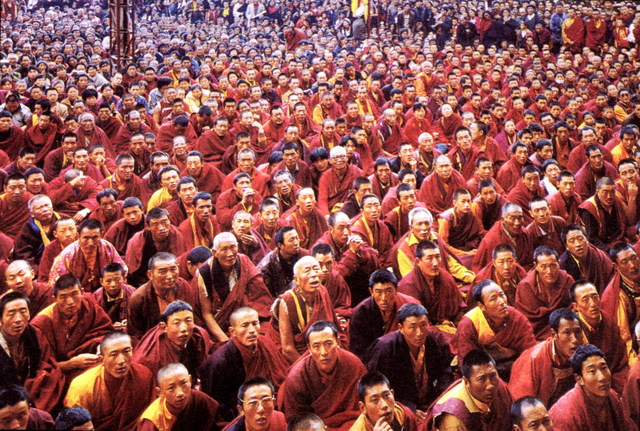
Buddhism and Democracy Đạo Phật và dân chủ
| | |
| Buddhism and Democracy
| Đạo Phật và dân chủ |
| Dalai Lama Washington, D.C., April 1993 | Dalai Lama Washington, D.C., tháng Tư 1993
|
| 1. For thousands of years people have been led to believe that only an authoritarian organization employing rigid disciplinary methods could govern human society. However, because people have an innate desire for freedom, the forces of liberty and oppression have been in continuous conflict throughout history. Today, it is clear which is winning. The emergence of peoples' power movements, overthrowing dictatorships of left and right, has shown indisputably that the human race can neither tolerate nor function properly under tyranny.
| Trong suốt hàng ngàn năm người ta đã lầm tưởng rằng chỉ có tổ chức chuyên chế xử dụng những biện pháp kỷ luật cứng rắn mới có thể trị vì được xã hội con người. Tuy nhiên, vì mong muốn tự nhiên của con người là được tự do, cho nên trong suốt chiều dài lịch sử lực lượng tự do và lực lượng trấn áp xung đột không ngừng lẫn nhau. Ngày nay rõ ràng là lực lượng nào đang thắng. Sự xuất hiện các phong trào quyền lực của nhân dân lật đổ các chế độ độc tài tả và hữu đã chứng minh hiển nhiên rằng nhân loại không thể nào chấp nhận chế độ độc đoán và cũng không thể nào hoạt động tốt được dưới chế độ ấy.
|
| 2. Although none of our Buddhist societies developed anything like democracy in their systems of government, I personally have great admiration for secular democracy. When Tibet was still free, we cultivated our natural isolation, mistakenly thinking that we could prolong our peace and security that way. Consequently, we paid little attention to the changes taking place in the world outside. We hardly noticed when India, one of our closest neighbours, having peacefully won her independence, became the largest democracy in the world. Later, we learned the hard way that in the international arena, as well as at home, freedom is something to be shared and enjoyed in the company of others, not kept to yourself.
| Tuy trong các xã hội Phật giáo không có xã hội nào phát triển được điều gì tương tự như nền dân chủ trong hệ thống chính quyền của họ, nhưng bản thân tôi lại rất khâm phục nền dân chủ thế tục. Thời Tây Tạng còn tự do, chúng tôi coi trọng sự biệt lập tự nhiên của mình, tưởng lầm rằng chúng tôi có thể duy trì được sự thanh bình yên ổn như thế mãi. Do vậy, chúng tôi không màng gì đến những thay đổi diễn ra ở thế giới bên ngoài. Chúng tôi hầu như không nhận thức khi Ấn Độ, một trong những nước láng giềng gần gủi chúng tôi nhất, sau khi giành được độc lập một cách êm ả, đã trở thành một nước dân chủ lớn nhất trên thế giới. Về sau chúng tôi mới cay đắng nhận ra rằng trên trường quốc tế hay ở trong nước tự do là điều ta nên chia xẻ và tận hưởng cùng với người khác, chứ không giữ riêng cho mình.
|
| 3. Although the Tibetans outside Tibet have been reduced to the status of refugees, we have the freedom to exercise our rights. Our brothers and sisters in Tibet, despite being in their own country do not even have the right to life. Therefore, those of us in exile have had a responsibility to contemplate and plan for a future Tibet. Over the years, therefore, we have tried through various means to achieve a model of true democracy. The familiarity of all Tibetan exiles with the word 'democracy' shows this.
| Tuy những người Tây Tạng bên ngoài Tây Tạng giờ chỉ còn là những thân phận tỵ nạn, nhưng chúng tôi vẫn có tự do thực thi các quyền của mình. Trong khi đó, dù được sống trên quê hương, các anh chị em chúng tôi ở Tây Tạng thậm chí không có cả đến quyền sống. Cho nên trong chúng tôi những ai sống lưu vong đều có trách nhiệm nghĩ đến và phác họa ra tương lai của Tây Tạng. Vì thế, trong suốt nhiều năm qua và bằng nhiều phương tiện khác nhau chúng tôi đã cố gắng đạt đến mẫu mực của nền dân chủ đích thực. Điều này được chứng minh qua sự am hiểu tường tận của tất cả người Tây Tạng lưu vong về từ "dân chủ".
|
| 4. I have long looked forward to the time when we could devise a political system, suited both to our traditions and to the demands of the modern world. A democracy that has nonviolence and peace at its roots. We have recently embarked on changes that will further democratize and strengthen our administration in exile. For many reasons, I have decided that I will not be the head of, or play any role in the government when Tibet becomes independent. The future head of the Tibetan Government must be someone popularly elected by the people. There are many advantages to such a step and it will enable us to become a true and complete democracy. I hope that these moves will allow the people of Tibet to have a clear say in determining the future of their country.
| Từ lâu tôi đã mong đợi đến ngày chúng tôi có thể nghĩ ra hệ thống chính trị phù hợp với truyền thống của chúng tôi và với những đòi hỏi cấp bách của thế giới hiện đại. Một nền dân chủ có cội rễ là bất bạo động và bình an. Chúng tôi mới đây đã khởi sự những thay đổi nhằm sẽ dân chủ hoá hơn nữa để làm cho chính quyền lưu vong của mình thêm vững chắc. Vì nhiều lý do, tôi đã quyết định tôi sẽ không lãnh đạo hay đóng vai trò gì trong chính phủ khi Tây Tạng được độc lập. Nhà lãnh đạo tương lai của chính phủ Tây Tạng phải là người được đa số nhân dân bầu lên. Sự khởi đầu như thế sẽ mang đến nhiều điều lợi ích và nhờ bước đi ban đầu như thế chúng tôi sẽ có thể trở thành một nước dân chủ thật sự và hoàn toàn. Tôi hy vọng những bước ban đầu này sẽ cho phép nhân dân Tây Tạng có tiếng nói rõ ràng trong việc quyết định tương lai của nước mình.
|
| 5. Our democratization has reached out to Tibetans all over the world. I believe that future generations will consider these changes among the most important achievements of our experience in exile. Just as the introduction of Buddhism to Tibet cemented our nation, I am confident that the democratization of our society will add to the vitality of the Tibetan people and enable our decision-making institutions to reflect their heartfelt needs and aspirations.
| Sự dân chủ hoá của chúng tôi đã mở rộng đến những người Tây Tạng trên khắp thế giới. Tôi tin những thế hệ tương lai sẽ coi những thay đổi này thuộc về những thành tựu quan trọng nhất trong đời lưu vong của chúng tôi. Hoàn toàn giống như sự du nhập đạo Phật vào Tây Tạng đã hun đúc nên quốc gia chúng tôi, tôi tự tin rằng sự dân chủ hoá xã hội sẽ tăng thêm sinh lực cho nhân dân Tây Tạng và giúp các thể chế ban ra những quyết định quan trọng có thể phản ánh được những nhu cầu và nguyện vọng thật sự của nhân dân.
|
| 6. The idea that people can live together freely as individuals, equal in principle and therefore responsible for each other, essentially agrees with the Buddhist disposition. As Buddhists, we Tibetans revere human life as the most precious gift and regard the Buddha's philosophy and teaching as a path to the highest kind of freedom. A goal to be attained by men and women alike.
| Tư tưởng cho rằng con người có thể sống chung tự do với nhau như những cá nhân, bình đẳng về nguyên tắc và vì thế có trách nhiệm lẫn nhau, về cơ bản là hợp với Phật tánh. Là Phật tử, những người Tây Tạng chúng tôi tôn kính nhân sinh như quà tặng quý giá nhất và tôn trọng triết học và lời dạy của đức Phật như con đường đưa đến hình thái tự do cao quý nhất. Đây là mục tiêu mọi người dù nam hay nữ đều nên đạt đến.
|
| 7. The Buddha saw that life's very purpose is happiness. He also saw that while ignorance binds beings in endless frustration and suffering, wisdom is liberating. Modern democracy is based on the principle that all human beings are essentially equal, that each of us has an equal right to life, liberty, and happiness. Buddhism too recognises that human beings are entitled to dignity, that all members of the human family have an equal and inalienable right to liberty, not just in terms of political freedom, but also at the fundamental level of freedom from fear and want. Irrespective of whether we are rich or poor, educated or uneducated, belonging to one nation or another, to one religion or another, adhering to this ideology or that, each of us is just a human being like everyone else. Not only do we all desire happiness and seek to avoid suffering, but each of us has an equal right to pursue these goals.
| Đức Phật thấy mục đích thật sự của cuộc đời là hạnh phúc. Người cũng thấy tuy vô minh trói buộc chúng sinh trong triền miên phiền nảo và khổ lụy, nhưng trí huệ Bát nhã soi sáng con đường giải thoát. Dân chủ hiện đại được dựa trên nguyên tắc rằng tất cả mọi người cơ bản đều bình đẳng, rằng mỗi người trong chúng ta đều bình đẳng về quyền sống, tự do, và hạnh phúc. Đạo Phật cũng thừa nhận mọi người ai ai cũng đều có nhân phẩm, và tất cả những thành viên trong gia đình nhân loại đều có quyền tự do bình đẳng và bất khả xâm phạm, không chỉ về tự do chính trị, mà còn ở mức độ tự do cơ bản là thoát khỏi cảnh đói nghèo và sợ hãi. Không phân biệt kẻ giàu người nghèo, kẻ có học hay người vô học, người nước này hay nước khác, người theo tôn giáo này hay tôn giáo khác, người trung thành với ý thức hệ này hay ý thức hệ khác, mỗi người trong chúng ta đều vẫn chỉ là một con người như bao con người khác. Không những tất cả chúng ta đều mong muốn hạnh phúc và tìm cách tránh đau khổ, mà mỗi người trong chúng ta còn có quyền bình đẳng để mưu cầu những mục tiêu này.
|
| 8. The institution the Buddha established was the Sangha or monastic community, which functioned on largely democratic lines. Within this fraternity, individuals were equal, whatever their social class or caste origins. The only slight difference in status depended on seniority of ordination. Individual freedom, exemplified by liberation or enlightenment, was the primary focus of the entire community and was achieved by cultivating the mind in meditation. Nevertheless, day to day relations were conducted on the basis of generosity, consideration, and gentleness towards others. By pursuing the homeless life, monks detached themselves from the concerns of property. However, they did not live in total isolation. Their custom of begging for alms only served to strengthen their awareness of their dependence on other people. Within the community decisions were taken by vote and differences were settled by consensus. Thus, the Sangha served as a model for social equality, sharing of resources and democratic process.
| Thể chế đức Phật sáng lập ra là Sangha hay tăng đoàn, hoạt động theo đường lối chủ yếu dân chủ. Bên trong giáo đoàn này, cho dù giai cấp xã hội hay đẳng cấp xuất thân nào chăng nữa, mọi cá nhân đều bình đẳng. Khác biệt rất nhỏ duy nhất về địa vị phụ thuộc vào tuổi thọ giới. Tự do cá nhân, thể hiện qua sự giải thoát hay giác ngộ, là trọng tâm chính của toàn thể cộng đồng và được đạt đến nhờ tu tâm qua thiền quán. Tuy nhiên, quan hệ hằng ngày với nhau diễn ra trên nền tảng của lòng quảng đại, sự tương kính, và hoà nhã. Khi theo đuổi cuộc đời xuất gia, chư tăng đã lánh xa mọi lo toan của cải. Song họ không sống hoàn toàn biệt lập. Tục lệ khất thực chỉ để cho họ ý thức sâu sắc hơn sự phụ thuộc của họ vào người khác. Trong cộng đồng này mọi quyết định đều thông qua bằng lá phiếu và mọi khác biệt đều được giải quyết qua sự đồng thuận. Như thế Sangha là mẫu mực về sự bình đẳng xã hội, cùng chia xẻ tài sản chung và quá trình dân chủ.
|
| 9. Buddhism is essentially a practical doctrine. In addressing the fundamental problem of human suffering, it does not insist on a single solution. Recognising that human beings differ widely in their needs, dispositions and abilities, it acknowledges that the paths to peace and happiness are many. As a spiritual community its cohesion has sprung from a unifying sense of brotherhood and sisterhood. Without any apparent centralized authority Buddhism has endured for more than two thousand five hundred years. It has flourished in a diversity of forms, while repeatedly renewing, through study and practice, its roots in the teachings of the Buddha. This kind of pluralistic approach, in which individuals themselves are responsible, is very much in accord with a democratic outlook.
| Đạo Phật về cơ bản là giáo lý thực tế. Khi bắt đầu giải quyết vấn đề đau khổ của con người, đạo phật không khẳng định chỉ có một lời giải duy nhất. Do xác định con người vốn khác biệt nhau rất nhiều về nhu cầu, bản tánh và tài năng, nên đạo Phật thừa nhận có nhiều con đường đưa đến an lạc và hạnh phúc. Là cộng đồng tinh thần, sự gắn bó của cộng đồng bắt nguồn từ ý nghĩa hợp nhất của tình anh chị em. Đạo Phật đã trường tồn trong suốt hơn hai ngàn năm trăm năm tuy không có bất kỳ tổ chức lãnh đạo trung ương chính thức rõ ràng nào. Đạo Phật đã phát triển thành nhiều hình thức đa dạng, trong khi đó, nhờ tu tập, đạo đã không ngừng hiểu mới những lời giảng dạy căn bản của đức Phật. Muôn nẻo đường đưa đến đạo này, đều do chính các cá nhân chịu trách nhiệm, rất hợp với quan điểm dân chủ.
|
| 10. We all desire freedom, but what distinguishes human beings is their intelligence. As free human beings we can use our unique intelligence to try to understand ourselves and our world. The Buddha made it clear that his followers were not to take even what he said at face value, but were to examine and test it as a goldsmith tests the quality of gold. But if we are prevented from using our discrimination and creativity, we lose one of the basic characteristics of a human being. Therefore, the political, social and cultural freedom that democracy entails is of immense value and importance.
| Chúng ta ai ai cũng muốn tự do, nhưng con người nổi bật là nhờ ở thông minh. Là người tự do chúng ta có thể dùng sự thông minh duy nhất này để cố gắng hiểu mình và hiểu đời. Đức Phật dạy rất rõ ràng ngay cả các Phật tử không nên tiếp nhận mà không suy nghĩ lời dạy của Người, mà phải suy xét và kiểm chứng những lời dạy ấy như người thợ kim hoàn thử chất lượng của vàng. Nhưng nếu chúng ta bị ngăn cấm không được dùng đến khả năng phân biệt và óc sáng tạo của mình, thì chúng ta đánh mất đi một trong những đặc trưng cơ bản của con người. Vì thế, tự do chính trị, xã hội và văn hoá mà nền dân chủ tạo ra có giá trị và tầm quan trọng vô cùng.
|
| 11. No system of government is perfect, but democracy is closest to our essential human nature. It is also the only stable foundation upon which a just and free global political structure can be built. So it is in all our interests that those of us who already enjoy democracy should actively support everybody's right to do so.
| Không có hệ thống chính quyền nào hoàn thiện, nhưng dân chủ lại gần gủi nhất với bản chất cơ bản của con người. Dân chủ cũng là nền tảng trên đấy con người có thể dựng lên cấu trúc chính trị công bằng và tự do trên phạm vi toàn cầu. Cho nên vì quyền lợi của tất cả chúng ta những ai trong chúng ta đang hưởng dân chủ nên tích cực ủng hộ quyền được hưởng dân chủ như thế của tất cả mọi người.
|
| 12. Although communism espoused many noble ideals, including altruism, the attempt by its governing elites to dictate their views proved disastrous. These governments went to tremendous lengths to control their societies and to induce their citizens to work for the common good. Rigid organisation may have been necessary at first to overcome previously oppressive regimes. Once that goal was fulfilled, however, such rigidity had very little to contribute to building a truly cooperative society. Communism failed utterly because it relied on force to promote its beliefs. Ultimately, human nature was unable to sustain the suffering it produced.
| Mặc dù chủ nghĩa cộng sản theo đuổi nhiều lý tưởng cao quý, trong đó có sự xả thân quên mình, nhưng nỗ lực của tầng lớp cầm quyền cao nhất để áp đặt quan điểm của họ đã gây ra bao thảm khốc. Những chính quyền này đã tìm đủ mọi cách nhằm kiểm soát xã hội và xúi dục nhân dân của họ làm việc vì lợi ích chung. Ban đầu tổ chức theo đường lối cứng rắn có thể cần thiết để đánh bại được các chế độ áp bức cũ. Tuy nhiên một khi mục tiêu ấy đã đạt được, sự cứng rắn như thế lại đóng góp rất ít vào công cuộc xây dựng xã hội thật sự hợp tác. Chủ nghĩa cộng sản đã thất bại hoàn toàn vì nó dựa vào vũ lực để cổ vũ cho niềm tin của mình. Cuối cùng, bản chất con người không thể nào chịu đựng mãi đau khổ do chủ nghĩa này gây ra.
|
| 13. Brute force, no matter how strongly applied, can never subdue the basic human desire for freedom. The hundreds of thousands of people who marched in the cities of Eastern Europe proved this. They simply expressed the human need for freedom and democracy. Their demands had nothing to do with some new ideology; they were simply expressing their heartfelt desire for freedom. It is not enough, as communist systems have assumed, merely to provide people with food, shelter and clothing. Our deeper nature requires that we breathe the precious air of liberty.
| Vũ lực tàn bạo, dù có được áp dụng mạnh mẽ đến đâu chăng nữa, vẫn không bao giờ có thể dập tắt nổi niềm mơ ước tự do căn bản ở con người. Hàng trăm ngàn người xuống đường ở các thành phố Đông Âu đã minh chứng điều này. Họ chỉ thể hiện nhu cầu tự do và dân chủ của con người. Những đòi hỏi của họ chẳng có liên quan gì đến ý thức hệ mới nào; họ chỉ muốn bày tỏ niềm ao ước tự do chân thành của mình. Không như các chế độ cộng sản tưởng rằng ngưòi ta chỉ cần có cơm ăn, áo mặc, và nơi ở, là đủ. Bản chất sâu xa hơn trong con người còn đòi hỏi chúng ta phải thở được khí trời tự do quý giá.
|
| 14. The peaceful revolutions in the former Soviet Union and Eastern Europe have taught us many great lessons. One is the value of truth. People do not like to be bullied, cheated or lied to by either an individual or a system. Such acts are contrary to the essential human spirit. Therefore, those who practice deception and use force may achieve considerable short-term success, but eventually they will be overthrown.
| Các cuộc cách mạng ôn hoà ở Liên Xô và Đông Âu cũ đã cho chúng ta nhiều bài học lớn. Một bài học về giá trị của sự thật. Người ta không ai thích bị bắt nạt, bị lường gạt hay bị lừa dối dù bởi cá nhân hay chế độ. Những hành động như thế đi ngược lại tinh thần cơ bản của con người. Vì vậy, những ai thực hành sự gian dối và dùng đến vũ lực có thể đạt được thành công đáng kể ngắn hạn, nhưng rồi cuối cùng họ nhất định sẽ bị lật đổ.
|
| 15. Truth is the best guarantor and the real foundation of freedom and democracy. It does not matter whether you are weak or strong or whether your cause has many or few adherents, truth will still prevail. Recently, many successful freedom movements have been based on the true expression of people's most basic feelings. This is a valuable reminder that truth itself is still seriously lacking in much of our political life. Especially in the conduct of international relations we pay very little respect to truth. Inevitably, weaker nations are manipulated and oppressed by stronger ones, just as the weaker sections of most societies suffer at the hands of the more affluent and powerful. In the past, the simple expression of truth has usually been dismissed as unrealistic, but these last few years have proved that it is an immense force in the human mind, and, as a result, in the shaping of history.
| Sự thật là người bảo đảm tốt nhất và là nền tảng thật sự của tự do và dân chủ. Không quan trọng là ta yếu hay ta mạnh hay sự nghiệp ta đeo đuổi có ít hay nhiều người theo, sự thật vẫn luôn luôn thắng. Mới đây, nhiều phong trào tự do thành công đều dựa trên sự bày tỏ chân thật những tâm tư căn bản nhất của con người. Đây là một sự nhắc nhở quý giá rằng chính sự thật vẫn hiện đang thiếu trầm trọng trong đa phần cuộc sống chính trị của chúng ta. Nhất là trong sự hành xử trong các quan hệ quốc tế chúng ta lại càng rất ít tôn trọng sự thật. Tất yếu, các nước yếu hơn bị các nước mạnh hơn nhào nặn và lấn áp, tựa như những thành phần yếu thế trong đa số các xã hội chịu đau khổ dưới tay của thành phần giàu có hơn và quyền thế hơn. Trong quá khứ, sự bày tỏ sự thật đơn thuần thường bị bỏ qua vì xem là không thực tế, nhưng những năm vừa qua này đã chứng minh sự thật là một sức mạnh vô cùng lớn trong tâm hồn con người và, từ đấy, tạo ra sức mạnh vô cùng lớn quyết định dòng chảy của lịch sử.
|
| 16. As we approach the end of the twentieth century, we find that the world has grown smaller and the world's people have become almost one community. We are also being drawn together by the grave problems we face: overpopulation, dwindling natural resources, and an environmental crisis that threaten the very foundation of existence on this small planet we share. I believe that to meet the challenge of our times, human beings will have to develop a greater sense of universal responsibility. Each of us must learn to work not just for his or her own self, family or nation, but for the benefit of all humankind. Universal responsibility is the real key to human survival. It is the best foundation for world peace, the equitable use of natural resources, and the proper care of the environment.
| Khi chúng ta đến gần cuối thế kỷ hai mươi, chúng ta nhận ra rằng thế giới ngày càng thu nhỏ lại và mọi người trên thế giới càng nép lại bên nhau như trong cùng một cộng đồng. Chúng ta cũng tự đến gần nhau hơn qua những vấn đề nghiêm trọng chúng ta cùng đối diện: bùng nổ dân số, cạn kiệt tài nguyên, và khủng hoảng môi trường mà đe doạ đến chính nền tảng tồn tại trên hành tinh nhỏ bé chúng ta cùng chung sống này. Tôi tin để đương đầu với thử thách ấy, con người sẽ phải hình thành ý thức trách nhiệm phổ quát lớn lao hơn. Mỗi người trong chúng ta phải học để nổ lực không chỉ riêng cho bản thân, gia đình, quốc gia mình, nhưng cũng vì cho lợi ích chung của tất cả nhân loại. Trách nhiệm phổ quát là nhân tố thật sự rất quan trọng cho sự tồn vong của con người. Trách nhiệm ấy là nền tảng tốt nhất cho nền hoà bình thế giới, sự xử dụng bình đẳng tài nguyên, và bảo vệ tốt môi trường.
|
| 17. This urgent need for cooperation can only strengthen mankind, because it helps us recognize that the most secure foundation for the new world order is not simply broader political and economic alliances, but each individual's genuine practice of love and compassion. These qualities are the ultimate source of human happiness, and our need for them lies at the very core of our being. The practice of compassion is not just a symptom of unrealistic idealism, but the most effective way to pursue the best interests of others as well our own. The more we - as nations or as individuals - depend upon others, the more it is in our own best interests to ensure their well-being.
| Nhu cầu hợp tác cấp thiết này chỉ tăng thêm sức mạnh cho nhân loại, bởi lẽ nhu cầu ấy giúp chúng ta thừa nhận rằng nền tảng vững bền nhất cho nền trật tự thế giới mới không phải đơn thuần là các liên minh chính trị và kinh tế rộng mở hơn, mà chính là sự thực hành đích thực tình thương yêu và lòng từ bi ở từng cá nhân. Những phẩm hạnh này là suối nguồn hạnh phúc cao quý nhất của con người, và nhu cầu thương yêu và từ bi ấy chính là cốt lõi đời người chúng ta. Thực hành lòng từ bi thực ra không phải là sự biểu hiện lý tưởng không tưởng, nhưng là cách hữu hiệu nhất để theo đuổi quyền lợi tốt nhất cho người khác và cho mình. Dù là cá nhân hay quốc gia, chúng ta càng phụ thuộc vào người khác bao nhiêu thì vì quyền lợi tốt nhất của chính mình chúng ta càng nên tạo ra hạnh phúc cho họ.
|
| 18. Despite the rapid advances made by civilization in this century, I believe that the most immediate cause of our present dilemma is our undue emphasis solely on material development. We have become so engrossed in its pursuit that, without even knowing it, we have neglected to foster the most basic human needs of love, kindness, cooperation and caring. If we do not know someone or do not feel connected to a particular individual or group, we simply overlook their needs. And yet the development of human society is based entirely on people helping each other. Once we have lost the essential humanity that is our foundation, what is the point of pursuing only material improvement?
| Dù nền văn minh trong thế kỷ này đã tiến rất nhanh, tôi vẫn tin nguyên nhân trực tiếp nhất của vấn đề nan giải hiện nay là chúng ta đã quá nhấn mạnh chủ yếu vào sự phát triển vật chất. Chúng ta quá bận tâm đến sự mưu cầu vật chất đến độ ngay cả không biết rằng chúng ta đã không khích lệ nhu cầu căn bản nhất ở con người tức thương yêu, nhân ái, hợp tác và tương trợ. Nếu chúng ta không biết ai hay không cảm thấy gắn bó với nhóm hay cá nhân cụ thể nào, chúng ta đâu quan tâm đến nhu cầu của họ. Tuy nhiên sự phát triển của xã hội loài người là hoàn toàn nhờ vào sự giúp đỡ lẫn nhau giữa mọi người. Một khi chúng ta mất đi lòng nhân cơ bản vốn là nền tảng ấy của mình, thì ích lợi gì khi chỉ mưu cầu sự tiến bộ vật chất?
|
| 19. In the present circumstances, no one can afford to assume that someone else will solve our problems. Every individual has a responsibility to help guide our global family in the right direction and we must each assume that responsibility. What we have to aim at is the common cause of our society. If society as a whole is well off, every individual or association within it will naturally gain from it. They will naturally be happy. However, if society as a whole collapses, then where can we turn to fight for and demand our rights?
| Trong hoàn cảnh hiện nay, không ai có thể trông mong người khác sẽ giải quyết vấn đề thay cho mình. Mỗi cá nhân đều có trách nhiệm góp phần hướng dẫn đại gia đình toàn cầu của chúng ta đi theo chiều hướng đúng và chúng ta phải gánh vác trách nhiệm ấy. Điều chúng ta nhắm đến chính là sự nghiệp chung của cả xã hội. Nếu xã hội nói chung thịnh đạt, thì tự nhiên mỗi cá nhân hay tập thể trong xã hội đều có lợi. Còn nếu xã hội nói chung suy sụp, thì chúng ta còn biết mong vào đâu để đấu tranh và đòi hỏi các quyền của mình?
|
| 20. I, for one, truly believe that individuals can make a difference in society. As a Buddhist monk, I try to develop compassion myself - not just from a religious point of view, but from a humanitarian one as well. To encourage myself in this altruistic attitude, I sometimes find it helpful to imagine myself, a single individual, on one side and on the other a huge gathering of all other human beings. Then I ask myself, 'Whose interests are more important?' To me it is then quite clear that, however important I may feel, I am only one, while others form the majority. | Riêng tôi, tôi thật sự tin cá nhân có thể có ảnh hưởng tích cực đến xã hội. Là nhà sư Phật giáo, tôi cố gắng phát tâm từ bi của mình -không chỉ từ quan điểm tôn giáo, mà cũng từ quan điểm nhân đạo. Nhằm khuyến khích mình hướng đến thái độ vị tha này, đôi khi tôi thấy hữu ích khi hình dung mình, một cá nhân đứng riêng lẻ ở một bên, còn phía bên kia là cả một đám đông vô cùng lớn gồm tất cả những người khác . Rồi tôi tự hỏi: "Quyền lợi của ai quan trọng hơn?" Đối với tôi câu trả lời rất rõ ràng là, dù tôi cảm thấy mình quan trọng thế nào chăng nữa, tôi vẫn chỉ là một, còn họ là đa số. |
|
|
|
|
| Translated by Tran Quoc Viet |
|
|
|
| http://www.dalailama.com/messages/buddhism/buddhism-and-democracy | |
Subscribe to:
Posts (Atom)